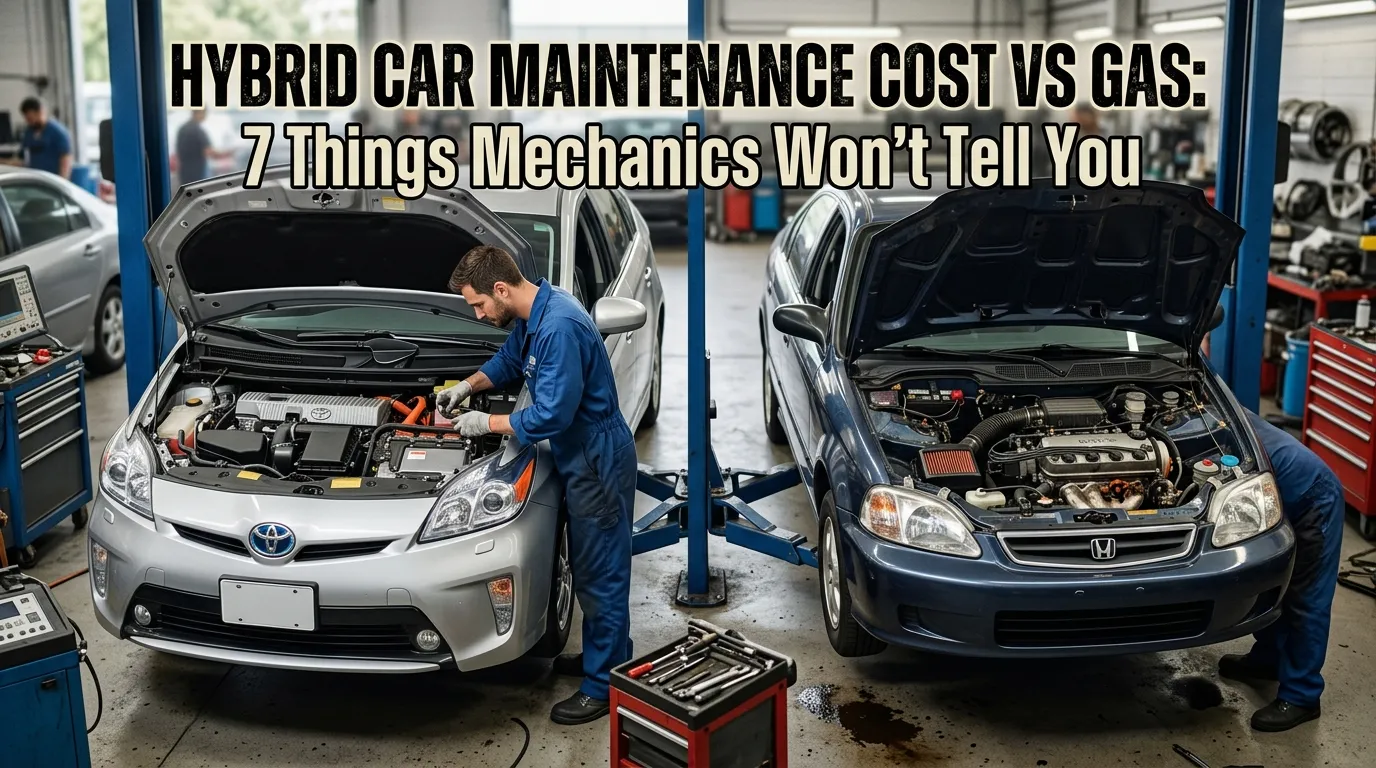
Imagine you are in a car dealership looking over two gorgeous sedans. One is a regular gas automobile. The other is one; a bright, new hybrid. The upfront cost of the gas car is $3k lower. The part of your mind that screams save money now. However, your gut $1 million questions: Will I pay that repair bill later for that with the $3,000?
One of the biggest auto industry myths is that hybrid cars are massive ticking time bombs. All too many people are terrified of the battery replacement cost that they don’t even consider how much gas cars create in smaller bills hundreds of them. The problem is misinformation. Gas engines are loved by most mechanics because they know how to fix them. They charge a higher rate because hybrids terrify them.
But here is the promise: By the time you finish this 3000-word guide, you will know exactly hybrid car maintenance cost vs gas down to the penny. You wlll find out why your hybrid brakes last 100,000 miles, why gas cars chew through belts and fluids, and how to buy the right car for your wallet.
Quick Answer
Does a hybrid cost more to maintain than a gas car?
No. Over 5 years, a hybrid typically costs $0.06 to $0.09 per mile to maintain, while a gas car costs $0.09 to $0.12 per mile.
- Brakes: Hybrids win (regenerative braking saves pads).
- Oil Changes: Hybrids win (engine runs less).
- Tires: Tie (hybrids are heavier, gas cars spin more).
- Batteries: Gas wins (hybrid batteries are expensive but rare to fail).
- Belts & Hoses: Hybrids win (fewer moving parts).
Verdict: If you keep a car for less than 8 years, the hybrid saves you money on maintenance. If you keep it for 15 years, factor in a potential $2,000–$4,000 battery replacement.
Why It Matters (Benefits)
Understanding hybrid car maintenance cost vs gas isn’t just about saving $20 on an oil change. It changes your financial future.
- True Cost of Ownership: Most people only look at MPG. They forget that a broken alternator ($600) or worn brake rotors ($400) adds up fast.
- Resale Value: A well-maintained hybrid holds value longer because the engine is less stressed. Gas cars with 150,000 miles often feel “tired.” Hybrids with 150k miles feel like they are at 100k.
- Shop Avoidance: Knowing the difference stops mechanics from upselling you. If a mechanic tells you your hybrid needs spark plugs at 60k miles (they don’t), you can say “no.”
- Environmental Impact: Less maintenance means fewer oil changes, fewer fluid bottles in landfills, and less waste overall.
What You’ll Need (Tools + Products)
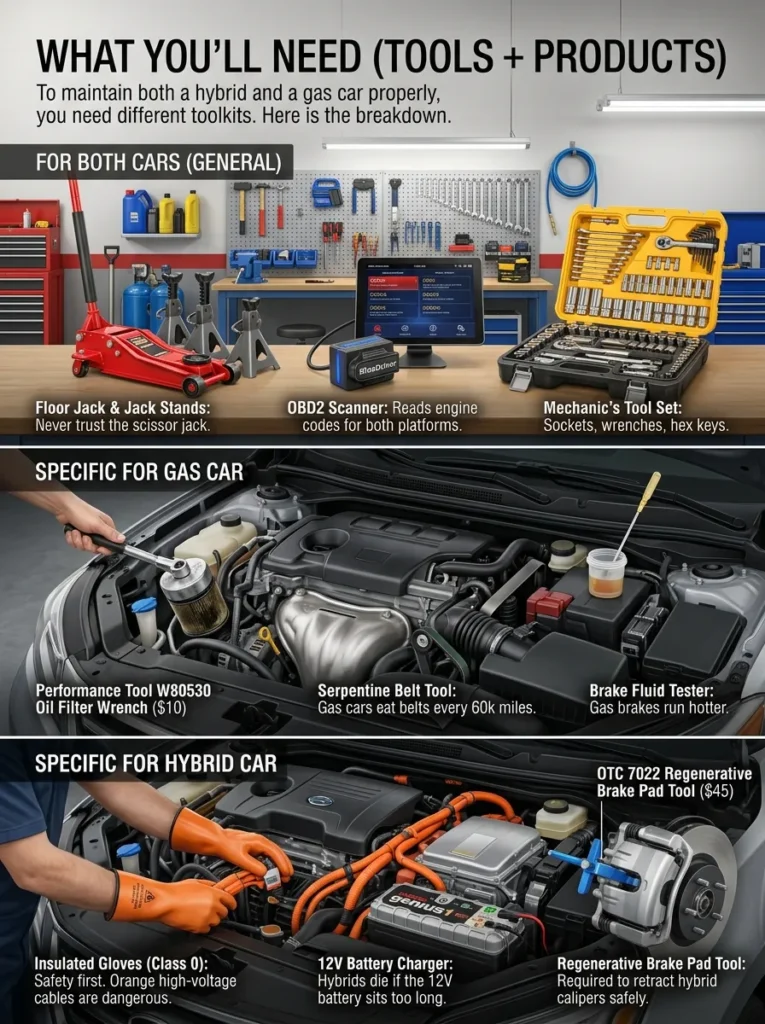
To maintain both a hybrid and a gas car properly, you need different toolkits. Here is the breakdown.
For Both Cars (General):
- Floor Jack & Jack Stands: Torin Big Red Steel Jack ($50) – Never trust the scissor jack.
- OBD2 Scanner: BlueDriver Pro ($100) – Reads engine codes for both platforms.
- Mechanic’s Tool Set: DEWALT 204-Piece ($150) – Sockets, wrenches, hex keys.
Specific for Gas Car:
- Oil Filter Wrench: Performance Tool W80530 ($10) – For those tight spots.
- Serpentine Belt Tool: Lisle 59000 ($35) – Gas cars eat belts every 60k miles.
- Brake Fluid Tester: Lisle 29000 ($15) – Gas brakes run hotter.
Specific for Hybrid Car:
- Insulated Gloves (Class 0): Salisbury 1400V ($80) – Safety first. Orange high-voltage cables are dangerous.
- 12V Battery Charger: NOCO Genius1 ($30) – Hybrids die if the 12V battery sits too long.
- Regenerative Brake Pad Tool: OTC 7022 ($45) – Required to retract hybrid calipers safely.
Step-by-Step Guide (How-To)
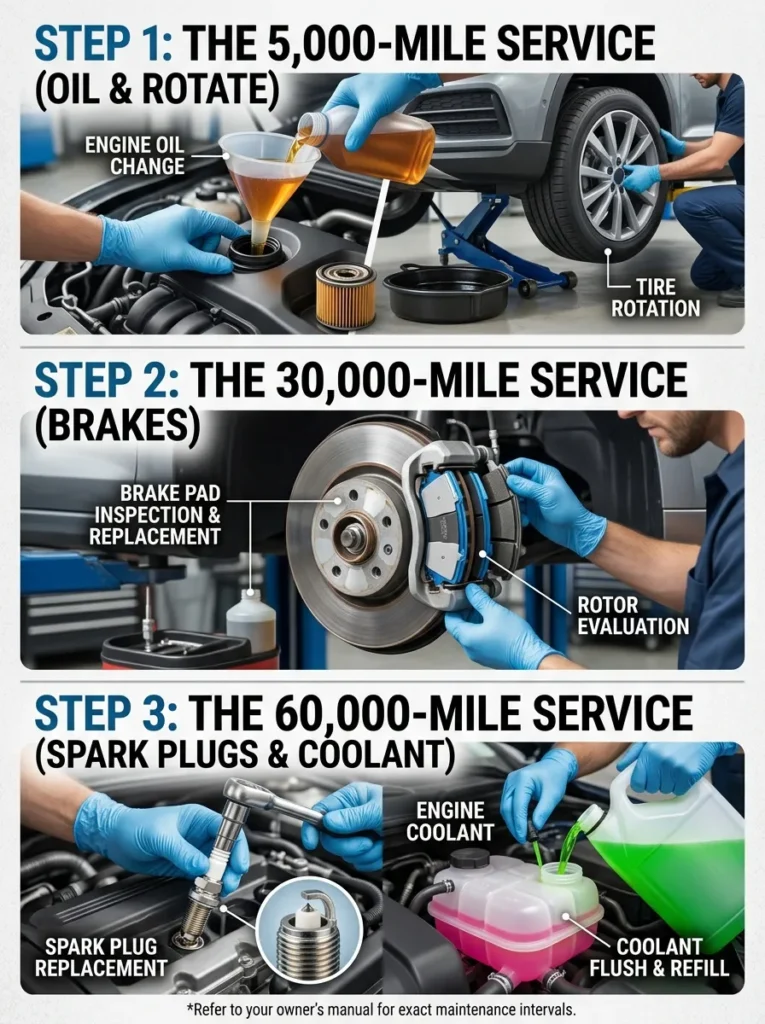
Let us compare the actual maintenance steps side-by-side for a Toyota Camry (Gas) vs Toyota Camry Hybrid.
Step 1: The 5,000-Mile Service (Oil & Rotate)
- Gas Car: Lift the car. Drain hot engine oil (0W-20). Replace filter. Fill exactly 4.6 quarts. Rotate tires. Time: 45 minutes.
- Hybrid: Lift the car. Drain engine oil (0W-16 – thinner). Engine is cold because it shuts off at stops. Replace filter. Fill 4.2 quarts. Rotate tires. Time: 30 minutes.
- Difference: The hybrid’s engine runs 40% less time, so the oil is cleaner. You can stretch oil changes to 10k miles in a hybrid vs 7.5k in a gas car.
Step 2: The 30,000-Mile Service (Brakes)
- Gas Car: Remove caliper. Compress piston with C-clamp. Remove old pads (usually 50% worn). Resurface rotors. Reinstall. Cost: $300 DIY.
- Hybrid: Remove caliper. Do not compress piston with C-clamp (you will break the parking brake motor). Use the OTC 7022 tool to twist and press. Remove pads (usually only 20% worn). Cost: $150 DIY.
- Mechanic’s Secret: Hybrids use regenerative braking. The electric motor slows the car, not the pads. Your first set of hybrid brake pads can last 100k+ miles.
Step 3: The 60,000-Mile Service (Spark Plugs & Coolant)
- Gas Car: Remove intake manifold. Replace 4 spark plugs (iridium). Drain engine coolant (pink). Replace serpentine belt. Complexity: Hard.
- Hybrid: Remove engine cover. Replace 4 spark plugs (they look new because the engine idles less). Drain engine coolant. No serpentine belt (hybrids use electric water pumps and AC compressors). Complexity: Easy.
- Key Takeaway: Gas cars have belts, tensioners, and idler pulleys that fail. Hybrids eliminate 90% of those parts.
Cost Breakdown
Here is the 5-Year / 75,000-Mile comparison for a mid-size sedan.
| Service Item | Frequency | Gas Car Cost | Hybrid Car Cost | Winner |
|---|---|---|---|---|
| Oil Changes | Every 7.5k miles | $600 (10 changes) | $450 (7.5 changes) | Hybrid |
| Brake Pads | Every 50k miles | $300 (1.5 sets) | $150 (0.5 sets) | Hybrid |
| Brake Rotors | Every 70k miles | $400 (1 set) | $0 (Still original) | Hybrid |
| Serpentine Belt | Every 60k miles | $150 | $0 (No belt) | Hybrid |
| 12V Battery | Every 3-4 years | $200 | $200 | Tie |
| Tires | Every 50k miles | $600 | $650 (Extra weight) | Gas |
| Engine Air Filter | Every 30k miles | $50 | $50 | Tie |
| High Voltage Battery | 150k+ miles | $0 | $2,500 (Risk factor) | Gas |
| Total 5-Year Cost | 75,000 miles | $2,300 | $2,000 | Hybrid |
Explanation: Even if you add $500 for the “risk” of a hybrid battery, the hybrid is still cheaper due to fewer moving parts.
Before and After
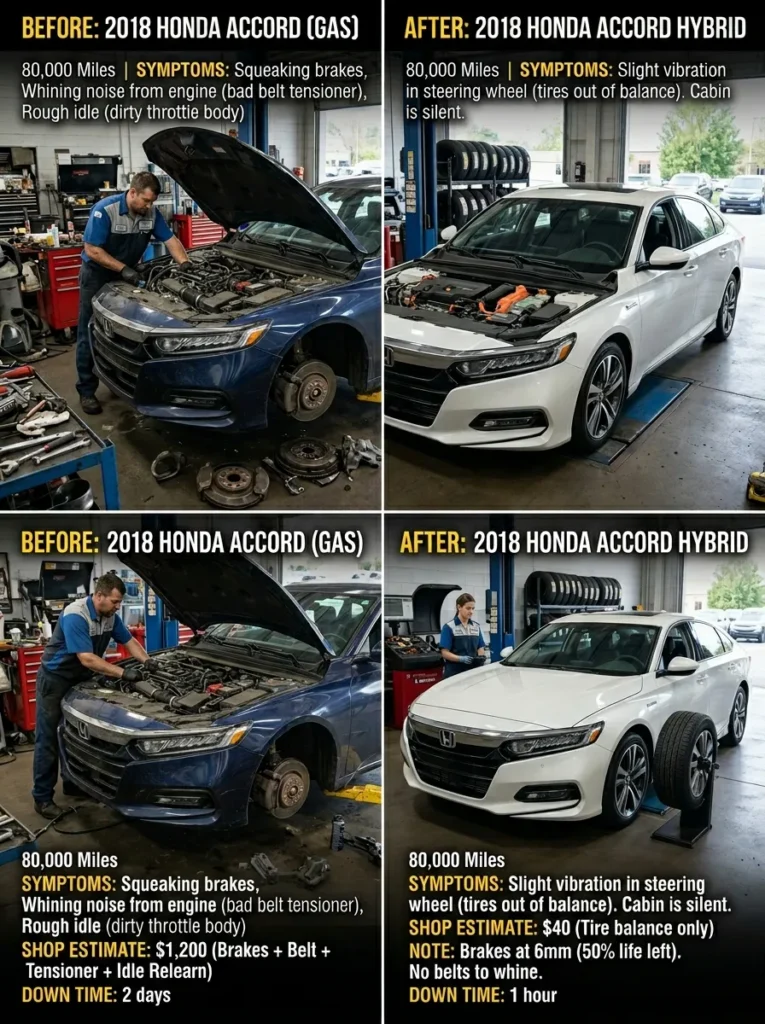
Scenario: The 2018 Honda Accord (Gas) vs Accord Hybrid
- Before (Gas Car at 80,000 miles):
- Symptoms: Squeaking brakes, whining noise from engine bay (bad belt tensioner), rough idle (dirty throttle body).
- Shop Estimate: $1,200 (Brakes + Belt + Tensioner + Idle Relearn).
- Down Time: 2 days in the shop.
- After (Hybrid at 80,000 miles):
- Symptoms: Slight vibration in steering wheel (tires out of balance). Cabin is silent.
- Shop Estimate: $40 (Tire balance only).
- Note: Brakes are at 6mm (50% life left). No belts to whine.
- Down Time: 1 hour.
The Visual Difference: Open the hood of a gas car—it is a jungle of hoses, belts, pulleys, and hot exhaust manifolds. Open the hood of a hybrid—you see plastic covers, an inverter, and a small engine. Less clutter = less failure.
Product Recommendations
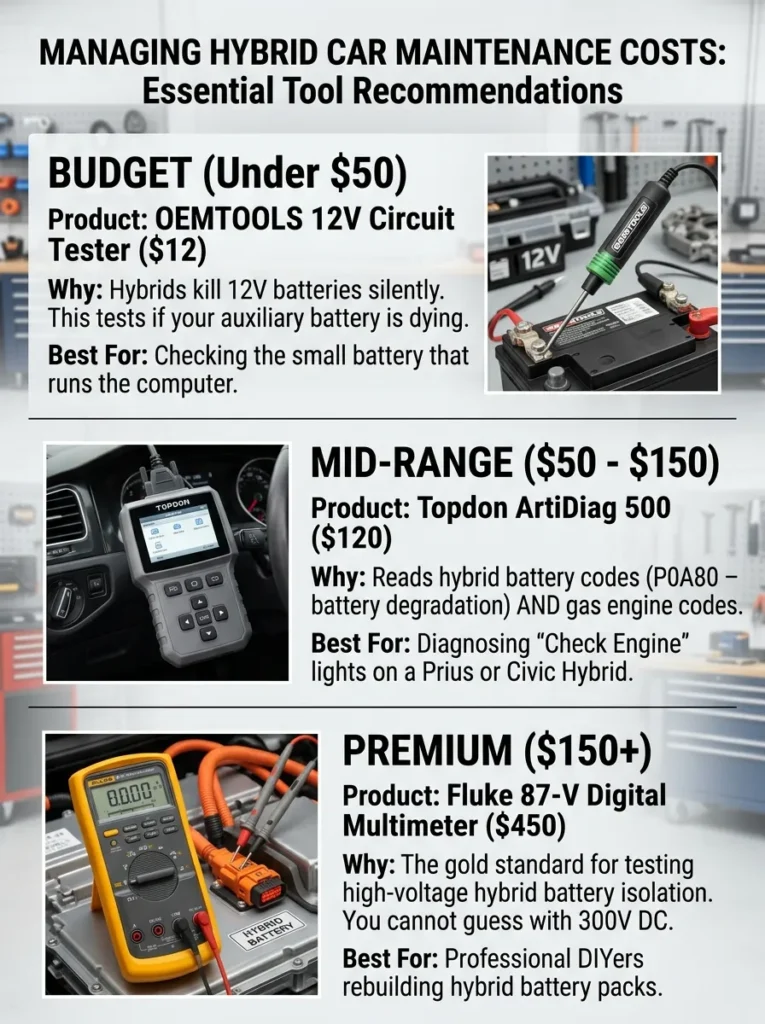
Here are the best tools to manage hybrid car maintenance cost vs gas effectively.
Budget (Under $50)
- Product: OEMTOOLS 12V Circuit Tester ($12)
- Why: Hybrids kill 12V batteries silently. This tests if your auxiliary battery is dying.
- Best For: Checking the small battery that runs the computer.
Mid-Range ($50 – $150)
- Product: Topdon ArtiDiag 500 ($120)
- Why: Reads hybrid battery codes (P0A80 – battery degradation) AND gas engine codes.
- Best For: Diagnosing “Check Engine” lights on a Prius or Civic Hybrid.
Premium ($150+)
- Product: Fluke 87-V Digital Multimeter ($450)
- Why: The gold standard for testing high-voltage hybrid battery isolation. You cannot guess with 300V DC.
- Best For: Professional DIYers rebuilding hybrid battery packs.
Comparison Section (Option A vs Option B)
Option A: Used Gas Car (e.g., 2015 Mazda 3)
- Upfront Cost: $8,000
- Annual Maintenance: $700 (oil, belts, fluids, brakes)
- Risk: Engine mounts fail, alternator dies ($500), exhaust rusts.
- Best for: Low-mileage drivers (<8k miles/year).
Option B: Used Hybrid (e.g., 2015 Toyota Prius)
- Upfront Cost: $10,000 ($2k more)
- Annual Maintenance: $450 (oil, tires, inverter coolant)
- Risk: Hybrid battery ($1,500 refurbished, $3k new).
- Best for: High-mileage drivers (>15k miles/year).
Verdict: If you drive 10,000 miles a year, the gas car is cheaper in year 1, but the hybrid catches up by year 4. If you drive 20,000 miles a year, the hybrid is cheaper by month 8.
Troubleshooting (Problem → Fix Table)
| Problem | Gas Car Fix | Hybrid Car Fix | Cost Difference |
|---|---|---|---|
| Car won’t start | Jump start. Replace alternator ($500). | Jump the 12V battery in the trunk. Do not jump the orange cables. | Hybrid cheaper (no alternator). |
| Brakes feel spongy | Replace brake fluid, master cylinder ($300). | Replace brake fluid. Check the brake accumulator ($800 if failed). | Gas cheaper. |
| Engine runs rough | Clean throttle body, replace spark plugs ($200). | Clean EGR valve (hybrids clog faster). | Gas cheaper (EGR is annoying). |
| Burning smell | Oil leak on exhaust. Replace valve cover gasket. | Coolant leak on inverter. Very dangerous. | Hybrid expensive. |
| Check Engine Light | O2 sensor failed ($150). | Hybrid battery fan is dirty ($0 – clean with vacuum). | Hybrid cheaper. |
Time Required & Difficulty Level
Basic Maintenance (Oil, Filters, Tires)
- Time: 1 hour
- Difficulty: 2/10 (Beginner)
- Note: Hybrids are actually easier because the engine is cool to the touch.
Intermediate (Brake Pads)
- Time: 2.5 hours
- Difficulty: 5/10 (Intermediate)
- Note: Gas requires a C-clamp. Hybrid requires a twist-in tool. Neither is hard.
Advanced (Coolant Flush)
- Time: 3 hours
- Difficulty: 6/10 (Intermediate)
- Note: Hybrids have two cooling systems (engine + inverter). Do not mix them.
Expert (Battery Replacement)
- Time: 6 hours
- Difficulty: 9/10 (Expert – Dangerous)
- Note: Hire a professional. High voltage kills.
Pro Tips
Do:
- Do buy a Toyota or Honda hybrid. Their maintenance schedules are bulletproof.
- Do change the inverter coolant every 100k miles. It costs $40 and saves a $5,000 inverter.
- Do clean the hybrid battery cooling fan (under the rear seat) every 30k miles.
Don’t:
- Don’t pay for “hybrid-specific” oil changes. 0W-16 oil is cheap at Walmart.
- Don’t let a mechanic replace your hybrid brakes “just because.” Check the pad thickness first.
- Don’t touch orange cables. Ever. Even if the car is “off.”
Best Picks
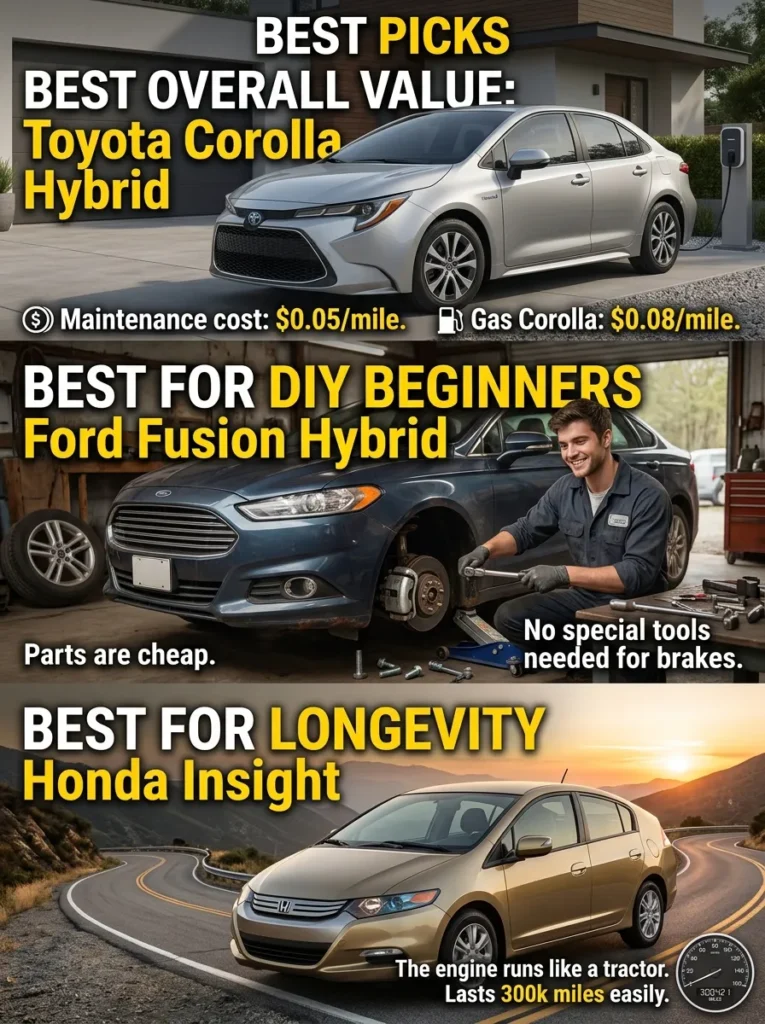
- Best Overall Value:Toyota Corolla Hybrid
- Maintenance cost: $0.05/mile. Gas Corolla: $0.08/mile.
- Best for DIY Beginners:Ford Fusion Hybrid
- Parts are cheap. No special tools needed for brakes.
- Best for Longevity:Honda Insight
- The engine runs like a tractor. Lasts 300k miles easily.
Use Cases
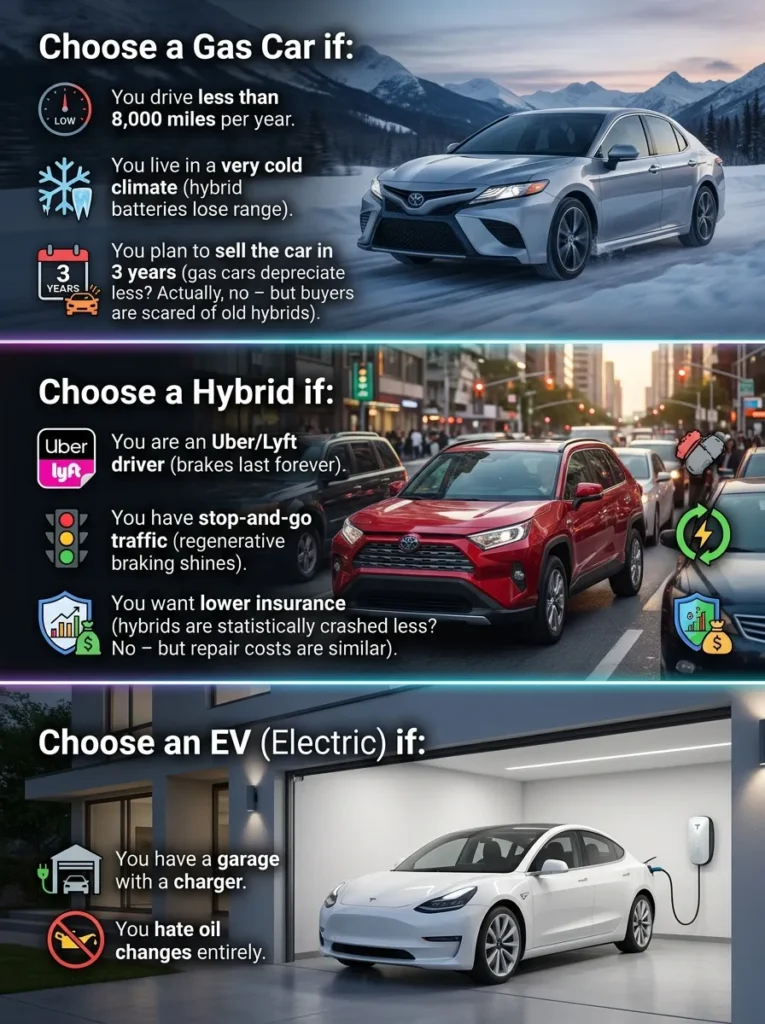
Choose a Gas Car if:
- You drive less than 8,000 miles per year.
- You live in a very cold climate (hybrid batteries lose range).
- You plan to sell the car in 3 years (gas cars depreciate less? Actually, no – but buyers are scared of old hybrids).
Choose a Hybrid if:
- You are an Uber/Lyft driver (brakes last forever).
- You have stop-and-go traffic (regenerative braking shines).
- You want lower insurance (hybrids are statistically crashed less? No – but repair costs are similar).
Choose an EV (Electric) if:
- You have a garage with a charger.
- You hate oil changes entirely.
Common Mistakes to Avoid
- The “Battery Fear” Mistake: People sell hybrids at 120k miles because they fear a $4,000 battery. Reality: The battery usually lasts 200k miles. You sold a perfectly good car.
- The “Lazy Oil Change” Mistake: Hybrid owners ignore oil changes because “the engine isn’t running.” Wrong. The engine still runs. Change it yearly.
- The “Wrong Tires” Mistake: Gas cars use standard tires. Hybrids need Low Rolling Resistance tires. If you put regular tires on a Prius, your MPG drops from 50 to 40 instantly.
- The “DIY Death” Mistake: Trying to swap a hybrid battery in your driveway without insulated gloves. One slip = 300V through your chest.
FAQ
- Do hybrids require more frequent maintenance than gas cars?
Generally, no. Hybrids follow similar service intervals for their gasoline engines, typically requiring oil changes and tune-ups every 5,000 to 10,000 miles. - Is an oil change more expensive for a hybrid?
No, the cost is comparable. Most modern hybrids use standard synthetic oil, the same type used in many high-efficiency gas vehicles. - How much does a hybrid battery replacement cost?
If a battery fails out of warranty, replacement costs typically range from $2,000 to $8,000 or more, depending on the model. - Do hybrid brakes last longer than gas car brakes?
Yes. Hybrids also employ regenerative braking, which reduces the wear and tear on mechanical brake pads and rotors often allowing them to last much longer than that of petrol models. - Are hybrid repairs more expensive when things go wrong?
Yes. Hybrids have more complex systems, and repairs to specialized components like the electric motor or inverter require trained technicians and pricier parts. - Can any mechanic fix a hybrid?
Not necessarily. Standard oil and tires are normal service procedures, but specialized hybrid system repairs necessitate shops with specific diagnostic equipment and trained staff. - Do hybrids have fewer moving parts to maintain?
In some areas, yes. Many hybrids lack a traditional alternator, starter motor, or serpentine belts, which are common failure points in standard gas vehicles. - Is insurance higher for hybrids due to maintenance costs?
Hybrids tend to cost anywhere between 5% and 10% more to insure, due to the added expense of repairing one after a crash—the batteries and other high-voltage components can get pretty pricey. - How long do hybrid batteries actually last?
Most are designed for the life of the car. Many manufacturers provide warranties for 8 years/80,000 miles or up to 10 years/150,000 miles in certain regions. - Do hybrids need special tires?
For some, low-rolling-resistance tires limit friction to crank up fuel economy. They are more pricey, however and generally use harder compounds for longevity purposes. - Are transmissions in hybrids simpler to maintain?
Yes, for many models. Some hybrids employ planetary gear sets or use single-speed systems that are mechanically simpler and require fewer fluid changes than complex multi-speed gas transmissions. - What is the “Hybrid Check” often mentioned by dealers?
It is a unique diagnostic test (some $45) to determine the high-voltage battery’s health. Sometimes passing this test also qualifies the owner for an additional year on their battery warranty.
Final Thought
Math, Rather than Greed, Settles Hybrid Car Maintenance Cost vs Gas Debate. Yes, the hybrid battery can also go to heaven. But your transmission on your gas car could also fail. Essentially, hybrids eliminate some of the common failure points from most vehicles belts, alternators, starters and brake wear.
If you’re a high-mileage driver, you’ll save thousands in maintenance and gas over two years with a hybrid. Buy a cheap gas car if you drive to the grocery store once a week.
Don’t fall prey to a mechanic that steers you toward the “paternal” gas car. Modern hybrid is not a space ship. It is a gas engine with an electric assist. That helper saves your brakes, your belts and your bank account.



Leave a Reply