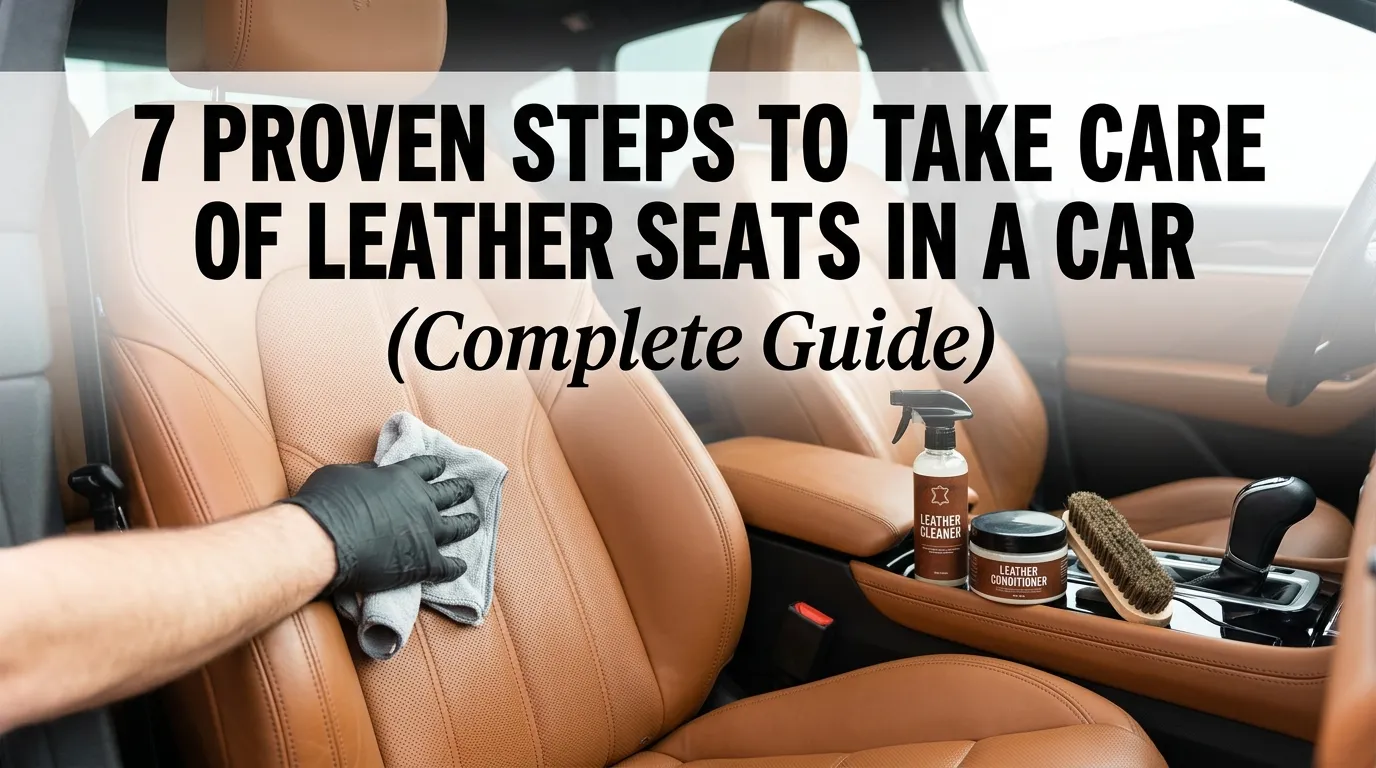
You paid a little more for the leather interior because it looks good, feels good, smells phenomenal. First, here is the hard truth; leather is dead animal skin! Much like your own skin, if you do not moisturize & protect it, your natural film will dry out, become brittle and eventually flake off.
Leather seats are one of those things want to forget about until they go horrible rotten and a nasty crack finds its way into the driver’s side bolster. At that point, the damage is done. Just one seat cover in leather can run $400 dollars to $1,200 dollars. Replacing all seats? Over $3,000.
But here is the good news. It takes 20 minutes a month less than the cost of pizza to learn how to care for leather seats in car Here, we show you how to care for your leather upholstery like a pro. No fancy tools required. No confusing chemicals. Just seven steps that work.
Quick Answer
To take care of leather seats in a car:
- Vacuum dirt from crevices first (dirt = sandpaper).
- Clean with a dedicated leather cleaner (not soap or wipes).
- Condition every 4-6 weeks to restore oils.
- Protect from UV rays using a leather sealant or ceramic coating.
- Never use bleach, ammonia, or general-purpose cleaners.
- Park in shade or use a windshield sun shade.
- Clean spills immediately (within 60 seconds).
Frequency: Light cleaning weekly. Deep cleaning + conditioning every 6-8 weeks.
Why It Matters
You might think, “They are just seats. Why bother?” Here is why.
1. Save Thousands of Dollars
A full leather reupholstery job costs $1,500–$3,500. Replacement seat covers from the dealership are $800–$2,000 per row. Regular maintenance costs $50 per year.
2. Maintain Resale Value
When you sell your car, cracked seats drop the value by 15–20%. A clean, soft leather interior tells buyers you took care of the entire car. On a $20,000 car, that is $3,000–$4,000 less.
3. Prevent Health Issues
Cracked leather absorbs sweat, bacteria, and food crumbs. Mold and mildew grow in those tiny cracks. You sit in that every single day.
4. Comfort & Safety
Conditioned leather stays soft and flexible. Hard, cracked leather is slippery. In a sudden stop, you slide forward. That affects your driving control.
5. Avoid Permanent Stains
Jeans transfer blue dye. Coffee leaves brown marks. Sunscreen creates white residue. Once these set into dry, porous leather, they are permanent. Proper sealing prevents absorption.
What You’ll Need (Tools and Products)
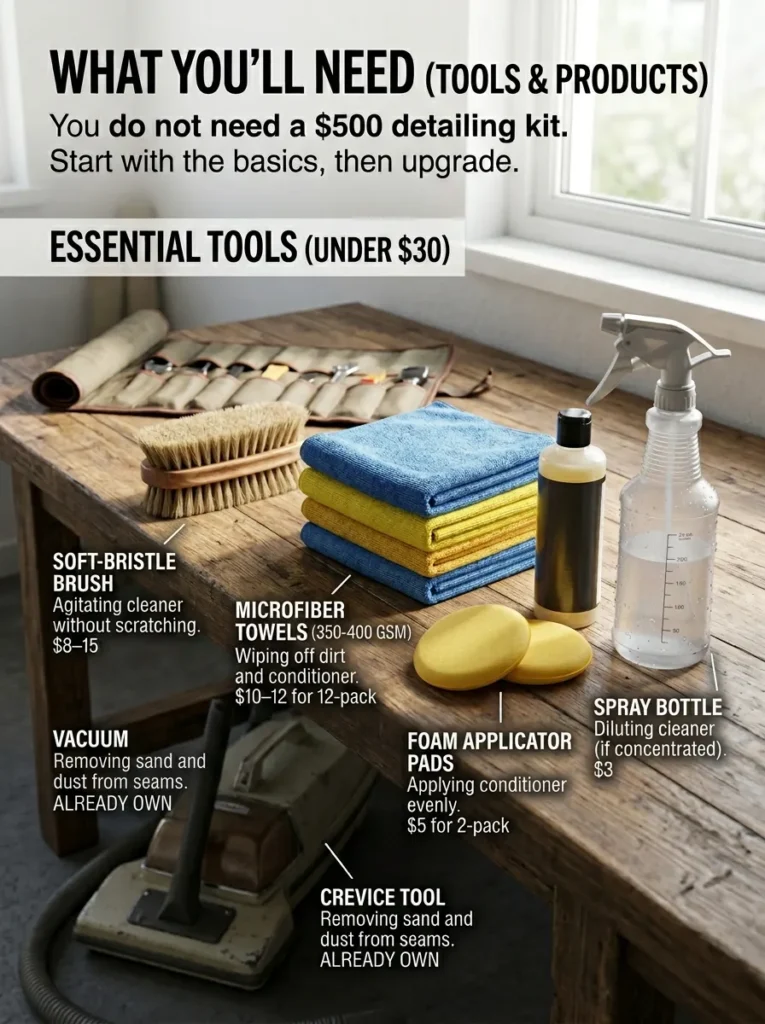
You do not need a $500 detailing kit. Start with the basics, then upgrade.
Essential Tools (Under $30)
| Tool | Purpose | Estimated Price |
|---|---|---|
| Soft-bristle brush (horsehair or boar’s hair) | Agitating cleaner without scratching | $8–15 |
| Microfiber towels (at least 6, 350-400 GSM) | Wiping off dirt and conditioner | $10–12 for 12-pack |
| Vacuum with crevice tool | Removing sand and dust from seams | Already own |
| Two foam applicator pads | Applying conditioner evenly | $5 for 2-pack |
| Spray bottle | Diluting cleaner (if concentrated) | $3 |
Cleaning Products (Choose One Line)
| Type | Product Example | Price | Best For |
|---|---|---|---|
| Budget | Chemical Guys Sprayable Leather Cleaner | $10 | Occasional cleaning |
| Mid | Griot’s Garage Leather Care Spray | $18 | Monthly maintenance |
| Premium | ColourLock Mild Leather Cleaner | $28 | New or sensitive leather |
Conditioning Products (Choose One)
| Type | Product Example | Price | Key Feature |
|---|---|---|---|
| Budget | Meguiar’s Gold Class Rich Leather Conditioner | $9 | Easy to find |
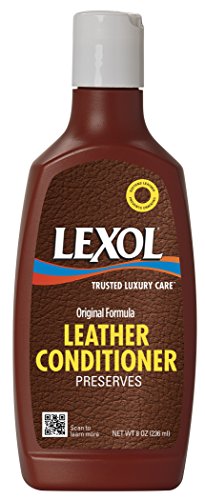
| Mid | Lexol Leather Conditioner | $15 | Non-greasy finish |
| Premium | Leather Honey Conditioner | $22 | Best for old/dry leather |
Protection Products (Optional but Recommended)
| Product | Price | Purpose |
|---|---|---|
| 303 Aerospace UV Protectant | $17 | Blocks UV rays, non-greasy |
| Gyeon Leather Shield (Ceramic) | $55 | 12-month protection |
Step-by-Step Guide: How to Take Care of Leather Seats in a Car
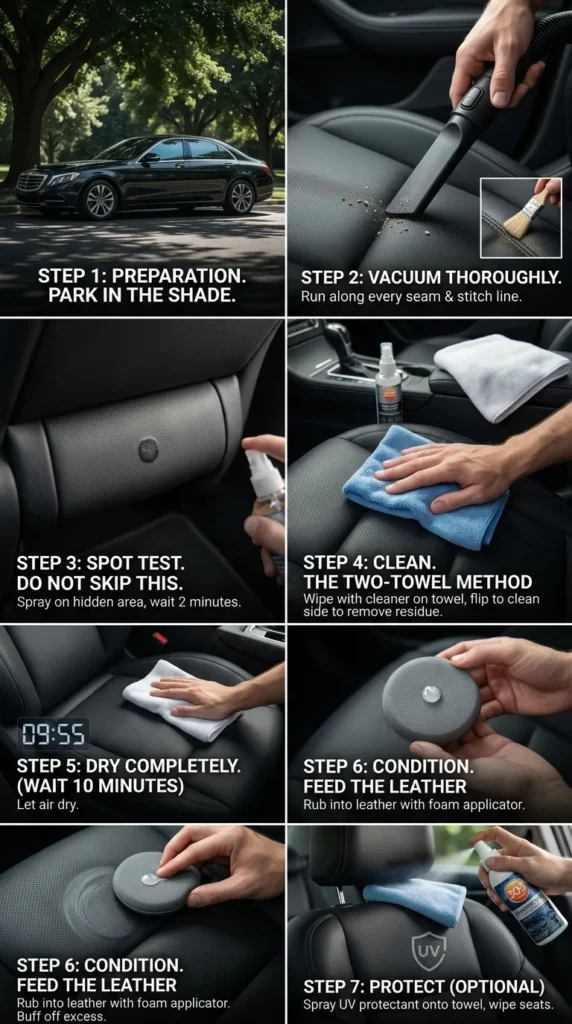
Step 1: Preparation – Park in the Shade
Heat opens leather pores, which sounds good but actually traps dirt deeper. Park in shade or wait until evening. Seats should be cool to the touch.
Step 2: Vacuum Thoroughly (The Most Overlooked Step)
Grab your vacuum with the crevice tool. Run it along every seam, stitch line, and bolster edge. Why? Dirt particles act like sandpaper. When you rub a cleaner with a towel, those tiny rocks scratch the clear coat of the leather. Vacuum until no dust rises.
Pro tip: Use a soft paintbrush to loosen dirt from stitching before vacuuming.
Step 3: Spot Test (Do Not Skip This)
Spray a tiny amount of your leather cleaner on a hidden area (under the seat or the back headrest). Wait 2 minutes. If the color changes or the surface gets sticky, do not use that product. Some cheap cleaners contain alcohol that strips factory coatings.
Step 4: Clean – The Two-Towel Method
- Spray leather cleaner directly onto a microfiber towel, not onto the seat.
- Wipe the seat in gentle circular motions.
- Flip the towel to a clean side. Wipe again to remove residue.
- For heavy dirt (blue jeans transfer), use a soft brush with the cleaner. Brush gently for 10 seconds, then wipe.
Important: Do not soak the leather. Too much liquid seeps into the foam underneath and causes mold.
Step 5: Dry Completely (Wait 10 Minutes)
After cleaning, take a dry microfiber towel and wipe the seats again. Let them air dry for 10 minutes. If you apply conditioner onto wet leather, it traps moisture and causes peeling.
Step 6: Condition – Feed the Leather
- Put a dime-sized amount of conditioner on a foam applicator pad.
- Rub it into the leather using small circular motions.
- Cover the entire seat surface, including sides and bolsters.
- Let it sit for 5–10 minutes.
- Buff off any excess with a clean microfiber towel.
How much conditioner? Less is more. If the seat looks greasy or shiny, you used too much. The finish should be matte, not wet.
Step 7: Protect (Optional but Smart)
Spray a UV protectant like 303 Aerospace onto a towel and wipe the seats. This adds a sacrificial layer that blocks UV rays. For ceramic leather coatings, follow the product instructions (usually requires 24 hours of no sitting).
Frequency Summary
- Weekly: Vacuum + wipe spills immediately.
- Every 6 weeks: Full clean + condition.
- Every 6 months: Deep clean + UV protectant reapplication.
Cost Breakdown
Here is exactly what you will spend in the first year vs. doing nothing.
| Item | DIY Cheap | DIY Mid-Range | Dealership/Pro | Doing Nothing |
|---|---|---|---|---|
| Initial Product Purchase | $25 | $55 | $150 (detail) | $0 |
| Yearly Product Refill | $12 | $25 | $300 (2 details) | $0 |
| Time Cost (1 hour/6 weeks) | $0 (your time) | $0 | $0 | $0 |
| Leather Repair After 2 Years | $0 | $0 | $0 | $800 (crack repair) |
| Resale Value Loss | $0 | $0 | $0 | $1,500–$3,000 |
| Total 2-Year Cost | $37 | $80 | $600 | $2,300+ |
Winner: DIY Mid-Range ($80 over 2 years vs. $2,300+ in losses).
Before and After
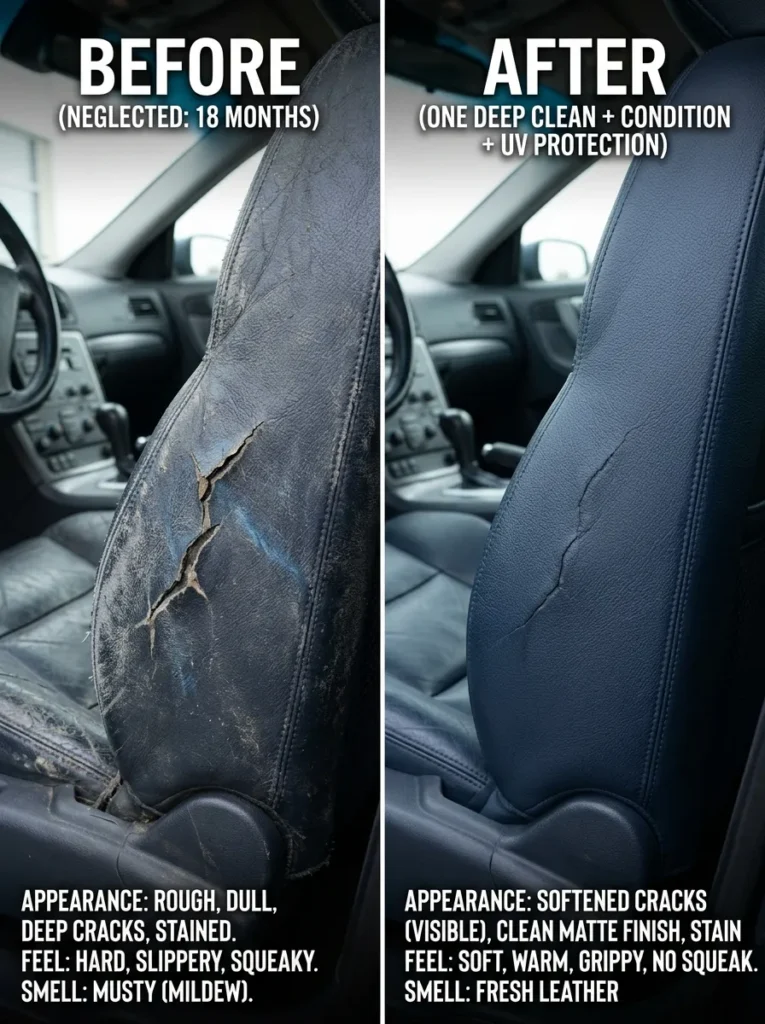
Before (Neglected for 18 Months)
- Appearance: Driver’s left bolster has two 2-inch cracks. Surface feels rough like sandpaper. Blue dye from jeans is permanently stained into the base. Crevices are filled with white sunscreen residue and black dirt.
- Feel: Hard, cold, and slippery. Makes a squeaking noise when you slide in.
- Smell: Slightly musty (mildew in cracks).
After (One Deep Clean + Condition + UV Protection)
- Appearance: Cracks are still visible (deep cracks cannot be reversed), but they are less noticeable because the edges are softened. Blue dye is 90% removed. Surface has a uniform matte finish.
- Feel: Soft, warm, and slightly tacky (grippy). No squeaking.
- Smell: Clean leather scent returns.
Realistic expectation: Conditioner fills micro-cracks but does not repair deep gashes. For deep cuts, you need a leather repair kit (filler compound + color match).
Product Recommendations
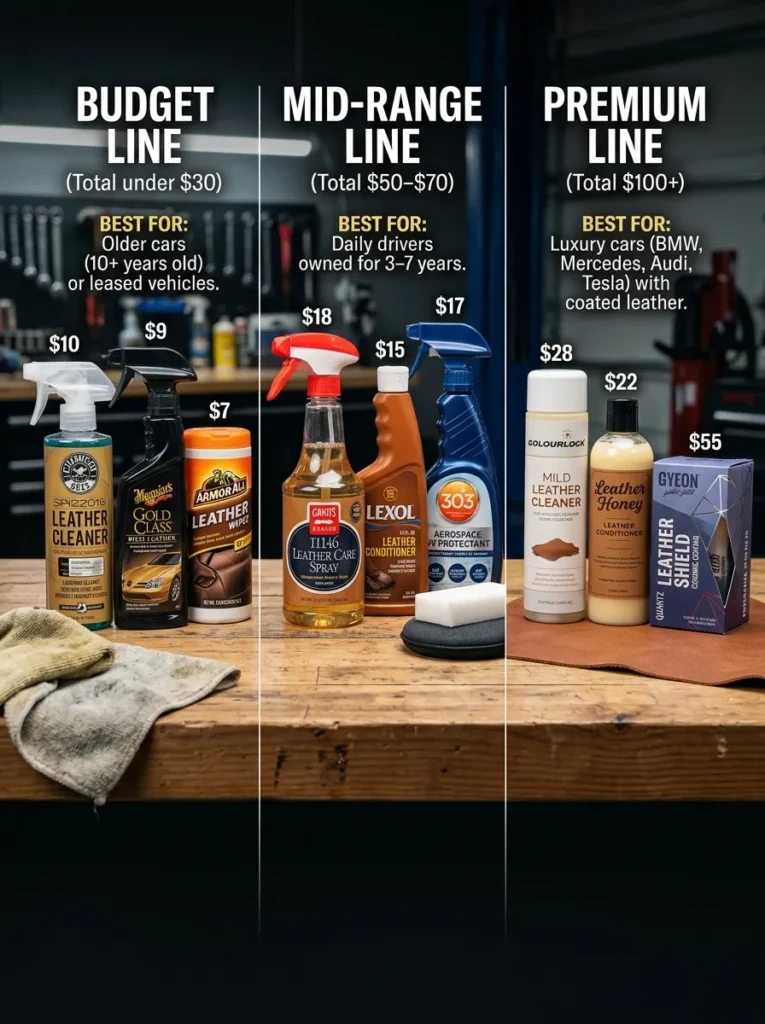
Budget Line (Total under $30)
- Cleaner: Chemical Guys SPI22016 Leather Cleaner ($10)
- Conditioner: Meguiar’s G4116 Gold Class Rich Leather ($9)
- Protectant: Armor All Leather Care Wipes ($7)
- Best for: Older cars (10+ years old) or leased vehicles.
Mid-Range Line (Total $50–$70)
- Cleaner: Griot’s Garage 11146 Leather Care Spray ($18)
- Conditioner: Lexol 1011-50 Leather Conditioner ($15)
- Protectant: 303 Aerospace UV Protectant ($17)
- Best for: Daily drivers owned for 3–7 years.
Premium Line (Total $100+)
- Cleaner: ColourLock Mild Leather Cleaner ($28)
- Conditioner: Leather Honey Leather Conditioner ($22)
- Protectant: Gyeon Quartz Leather Shield Ceramic Coating ($55)
- Best for: Luxury cars (BMW, Mercedes, Audi, Tesla) with coated leather.
Comparison Section: Leather Cleaner vs. Leather Conditioner
Many people think these are the same. They are not.
| Feature | Leather Cleaner | Leather Conditioner |
|---|---|---|
| Primary job | Remove dirt, oil, and stains | Replace lost oils and moisturize |
| Contains | Mild detergents, water, surfactants | Lanolin, waxes, neatsfoot oil, UV blockers |
| Texture | Thin liquid or spray | Thick lotion or cream |
| Effect on leather | Opens pores to release dirt | Closes pores and seals moisture |
| Frequency | Every cleaning (6-8 weeks) | Every 2nd cleaning (12-16 weeks) |
| What happens if you only use cleaner | Leather dries out and cracks within 6 months | Leather stays soft but dirty |
| What happens if you only use conditioner | Dirt gets sealed into the leather permanently | Leather becomes sticky and greasy |
Verdict: You need both. Clean first, then condition. Never reverse the order.
Troubleshooting
| Problem | Cause | DIY Fix | Professional Fix |
|---|---|---|---|
| White cracks in leather | Extreme dryness, UV damage | Apply Leather Honey conditioner twice, 24 hours apart | Leather respray or replacement |
| Blue jeans dye transfer | Low-quality leather + sweat | Use ColourLock Leather Dye Transfer Remover ($25) | Sanding + refinishing ($200) |
| Sticky/tacky surface | Too much conditioner or wrong product | Wipe with isopropyl alcohol (50/50 water mix) then re-clean | Steam cleaning ($75) |
| Mold spots (white/green) | Moisture trapped under conditioner | Wipe with white vinegar (50/50 water) | Ozone treatment + reupholster |
| Cracking on bolster | Normal wear from sliding in/out | Leather filler compound + color dye kit ($40) | Replace bolster panel ($300) |
| Peeling clear coat | Factory coating failing (common in Mercedes/Tesla) | Cannot DIY – coating is gone | Professional refinishing ($400) |
Time Required and Difficulty Level
| Task | Time | Difficulty (1-5) | Notes |
|---|---|---|---|
| Quick weekly wipe | 5 minutes | 1 (Very Easy) | Use a damp microfiber only |
| Full clean (2 seats) | 20–30 minutes | 2 (Easy) | Vacuum + clean + dry |
| Full clean + condition (2 seats) | 45 minutes | 2.5 (Easy) | Includes 10 min wait time |
| Deep clean + UV protectant (entire car) | 1.5 hours | 3 (Moderate) | Requires curing time |
| Leather crack repair | 2 hours | 4 (Difficult) | Easy to mess up color matching |
how to take care of leather seats in a car
Pro Tips
Do
- Do clean spills within 60 seconds. Blot, do not rub.
- Do use a sun shade on the windshield every single day.
- Do condition before a long road trip (heat dries leather faster).
- Do wear untreated cotton jeans (raw denim transfers less dye than treated denim).
- Do keep a small microfiber towel in your glove box for quick wipes.
Don’t
- Don’t use baby wipes. They contain moisturizers that make leather slippery and unsafe.
- Don’t use dish soap (Dawn). It strips the factory protective coating.
- Don’t use saddle soap. It is for horse saddles (thick, unfinished leather), not car seats (thin, coated leather).
- Don’t sit on leather with wet swimsuits. Chlorine and saltwater destroy the coating.
- Don’t use a stiff brush or scrub pad. You will remove the color layer.
Best Picks (Top 3 Summary)
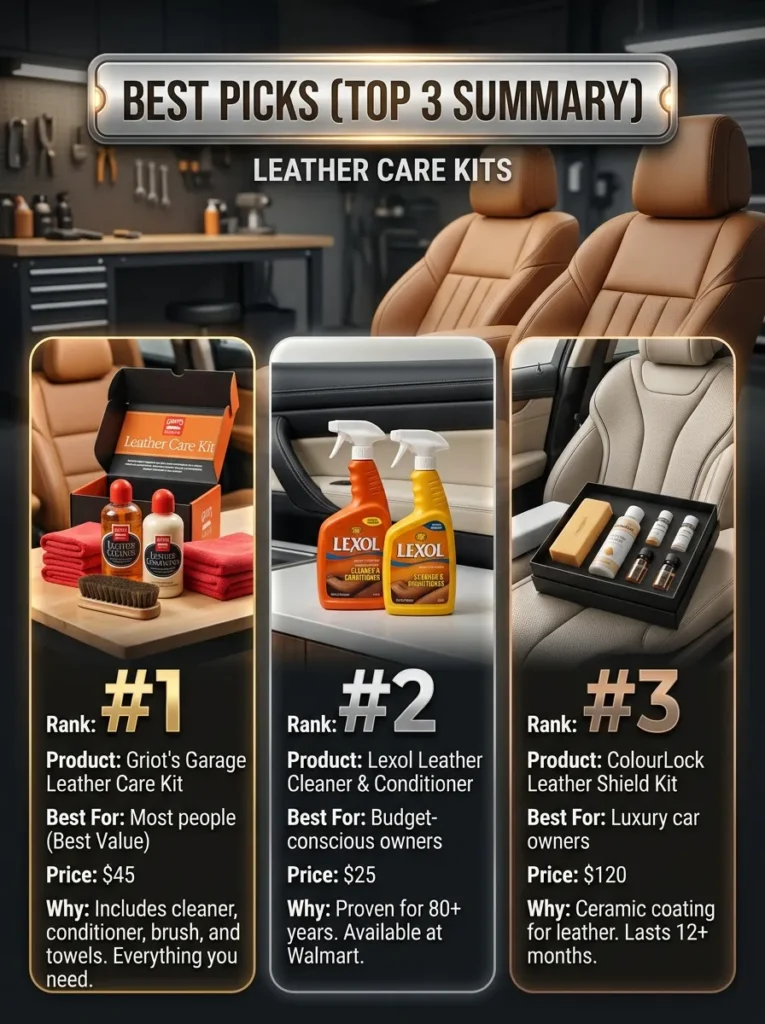
| Rank | Product | Best For | Price | Why |
|---|---|---|---|---|
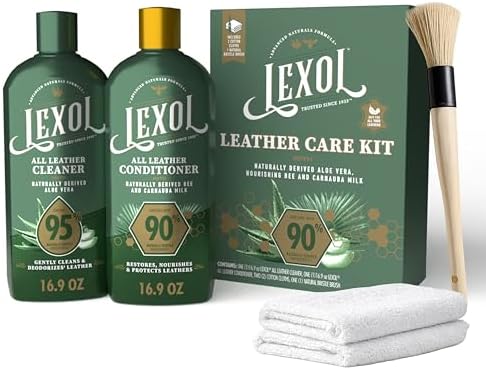
| #1 | Griot’s Garage Leather Care Kit | Most people (Best Value) | $45 | Includes cleaner, conditioner, brush, and towels. Everything you need. |
| #2 | Lexol Leather Cleaner & Conditioner | Budget-conscious owners | $25 | Proven for 80+ years. Available at Walmart. |
| #3 | ColourLock Leather Shield Kit | Luxury car owners | $120 | Ceramic coating for leather. Lasts 12+ months. |
Overall winner for 95% of drivers: Griot’s Garage Leather Care Kit ($45). It is idiot-proof, works on all leather types, and leaves a matte finish.
Use Cases (When to Choose What)
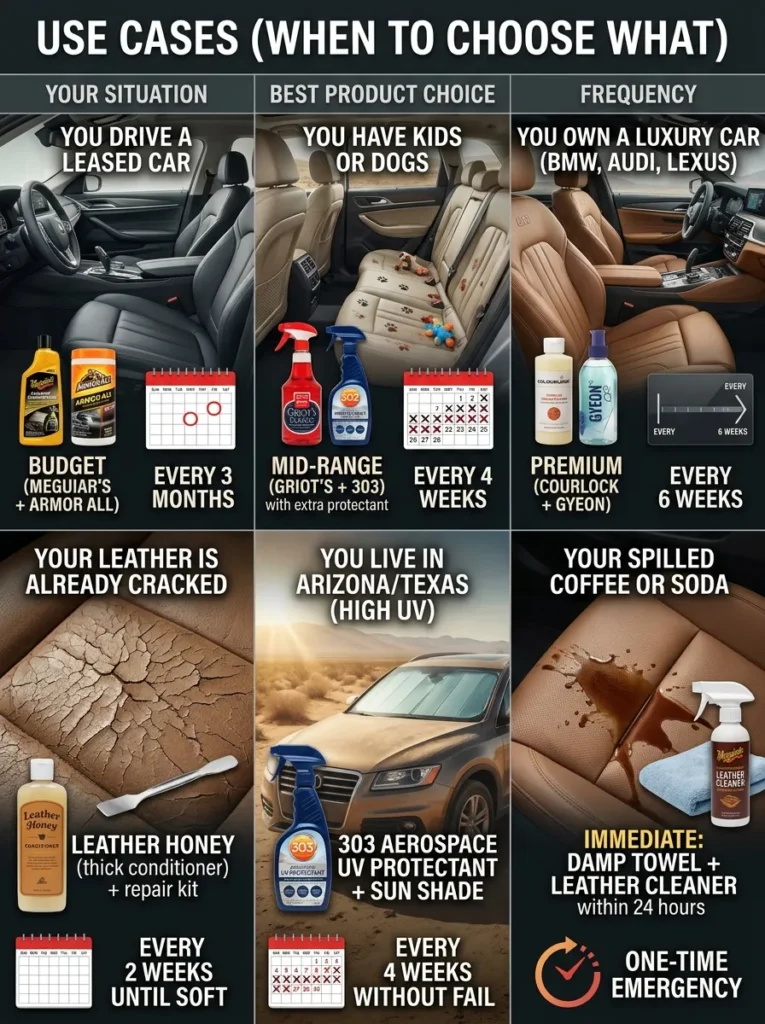
| Your Situation | Best Product Choice | Frequency |
|---|---|---|
| You drive a leased car | Budget (Meguiar’s + Armor All) | Every 3 months |
| You have kids or dogs | Mid-range (Griot’s + 303) with extra protectant | Every 4 weeks |
| You own a luxury car (BMW, Audi, Lexus) | Premium (ColourLock + Gyeon) | Every 6 weeks |
| Your leather is already cracked | Leather Honey (thick conditioner) + repair kit | Every 2 weeks until soft |
| You live in Arizona/Texas (high UV) | 303 Aerospace UV protectant + sun shade | Every 4 weeks without fail |
| You spilled coffee or soda | Immediate: Damp towel + leather cleaner within 24 hours | One-time emergency |
Common Mistakes to Avoid
Mistake #1: Using Leather Wipes as a Long-Term Solution
Armor All and Meguiar’s wipes are fine for a quick wipe, but they do not deep clean or condition. They leave a shiny, slippery film that attracts more dust.
Mistake #2: Conditioning Too Often
Conditioning every week clogs the leather’s pores. The surface becomes sticky and grabs dirt. Once every 6–8 weeks is plenty.
Mistake #3: Ignoring the Headrest and Rear Seats
Your headrest absorbs sweat and hair oils. Rear seats get sunscreen and food crumbs. Rotate your cleaning. Do not just clean the driver’s seat.
Mistake #4: Using Heat to Dry Leather
Some people use a hair dryer or park in the sun to speed up drying. Heat shrinks leather and causes cracking. Air dry only.
Mistake #5: Not Cleaning the Seat Belt
Your seat belt transfers body oils and dirt to the leather every time you buckle up. Wipe your seat belt with a damp cloth every month.
Affiliate Best Product Name Suggestion
If you are recommending one product for affiliate commissions, choose:
Griot’s Garage 11146 Leather Care Spray (Cleaner) + 11147 Conditioner Bundle
Why this converts well:
- Trusted brand among car enthusiasts (not a cheap Amazon unknown brand)
- Mid-range price ($35–45) – high enough for commission, low enough for impulse buy
- Solves the “which product do I buy?” confusion by offering a bundle
- Available on Amazon, Walmart, and AutoZone (high affiliate availability)
FAQs
1.How often should I clean and condition my seats?
Routine cleaning: Every 2–4 weeks for high-traffic cars.
Deep conditioning: Every 3–6 months to maintain suppleness.
2.What is the correct order for leather care?
Vacuum first: Remove debris that can scratch the finish.
Clean second: Use a dedicated cleaner to remove oils.
Condition last: Apply protectant only after the surface is clean.
3.Should I condition new leather car seats?
Yes, but focus on sealing rather than heavy oiling.
New leather benefits from UV protection and dye-transfer barriers.
4.Can I use household cleaners like dish soap or vinegar?
Avoid harsh soaps; they strip natural oils and cause cracking.
Use pH-balanced leather cleaners specifically for automotive use.
5.Are baby wipes safe for leather seats?
No. The chemicals in baby wipes can damage leather over time.
6.Do I need a special brush to clean leather?
A horsehair brush is recommended for agitating dirt in creases.
Avoid stiff-bristled brushes that might scratch the surface.
7.How do I prevent my leather seats from cracking?
Regular conditioning keeps the leather from becoming brittle.
Keep the interior ventilated to avoid moisture/heat damage.
8.How can I protect my seats from sun damage and fading?
Use UV-blocking conditioners or protectants.
Park in the shade or use sunshades whenever possible.
9.What is the “water test” for leather?
Drop a bit of water on a hidden area.
If it beads, the leather is coated (standard).
If it soaks in, it is uncoated (requires extra care).
10.How do I clean perforated leather without clogging the holes?
Apply cleaner to a microfiber cloth or brush, not the seat.
Wipe excess quickly to prevent moisture from soaking the foam.
11.How can I stop blue jean dye from staining my seats?
Use a leather sealant or guard specifically for dye transfer.
Clean light-colored seats more frequently to prevent buildup.
12.Can I use a steam cleaner on leather?
Not recommended. Excessive heat and moisture can damage the finish.
Final Thought
Car leather seat maintenance is not about perfection. It is about consistency.
A compounds do not require you to get a $200 ceramic coating or hire a professional detailer It only takes a $15 bottle of conditioner, a microfiber towel, and 20 minutes every six weeks. That’s a little habit that will save you $1,200 on reupholstery and add thousands to the resale value.
Today, buy a windshield sun shade the single biggest thing you can do. Eighty percent of leather damage is caused by UV rays. Nothing beats a $10 sunshade at protecting your seats.
Start today. Clean one seat. See the difference. Then do the rest tomorrow.

Leave a Reply