Set Product NameWhat you have been doing for 45 minutes scrubbing carpets on the floors with your hands and knees. Your shoulders ache. Your knuckles are raw. And the stain is still there. There has to be a better way.
There is. Instead of scrubbing something for 45 minutes manually, a drill with detailing attachments makes it five minutes of hardly even work. But here is the problem: Not every drill is suitable for detailing. If you use the wrong drill, you’re going to strip paint, burn upholstery or get half way through a single seat and run out of battery.
When it comes to the best drill for car detailing you need key features: variable speed trigger (not just two speeds), 1500+ RPM, light weight and comfortable grip. This guide will tell you precisely what those drills are, which attachments you require and how to use them safely. In the end you will save half of your detailing time and obtain professional results
Quick Answer
What is the best drill for car detailing?
- Best overall: DeWalt DCD794 (20V cordless, variable trigger, 1700 RPM)
- Best budget: Hyper Tough 20V Cordless Drill ($35 – Walmart)
- Best for professionals: Milwaukee M18 Fuel (1800 RPM, 5-year warranty)
- Best corded (unlimited runtime): Makita DA3010 (2400 RPM, lightweight)
Key features you need:
- Variable speed trigger (not lock-on only)
- 1500+ RPM maximum speed
- Under 4 lbs (with battery)
- 1/2″ keyless chuck (fits all detailing attachments)
Attachments you will buy separately:
- Carpet brush (stiff nylon)
- Upholstery brush (soft boar’s hair)
- Foam polishing pad
- Microfiber pad
- Extension hose (for tight spaces)
Why It Matters
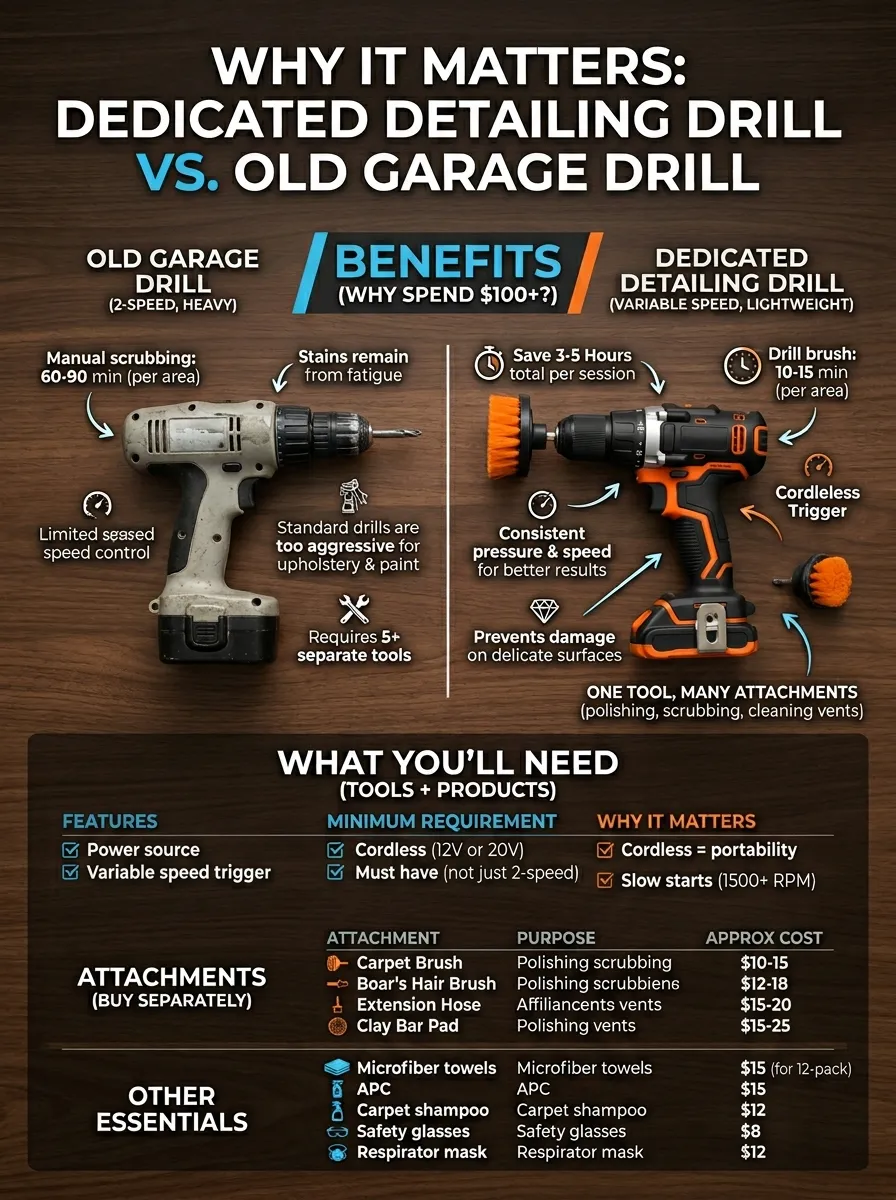
Why spend $100+ on a dedicated detailing drill instead of using the old drill in your garage?
- Save 3-5 Hours Per Detailing Session: Manual scrubbing of carpets takes 60-90 minutes. A drill brush does it in 10-15 minutes. That is time you can spend on other areas.
- Better Results (Less Fatigue): When your arm gets tired, you scrub less aggressively. Stains remain. A drill applies consistent pressure and speed for the entire job.
- Prevents Damage: Detailing drills have variable speed triggers. You start slow, then increase speed. Standard drills with two speeds (slow/fast) are too aggressive for upholstery and paint.
- One Tool, Many Attachments: The same drill polishes headlights, scrubs carpets, cleans vents, applies wax, and removes swirl marks. You buy one drill and five attachments instead of five dedicated tools.
- Professional Detailing Standard: Every professional mobile detailer carries a cordless drill with brush attachments. It is not a luxury. It is a productivity necessity.
What You’ll Need
| Feature | Minimum Requirement | Why It Matters |
|---|---|---|
| Power source | Cordless (12V or 20V) or Corded | Cordless = portability. Corded = unlimited runtime. |
| Variable speed trigger | Must have (not just 2-speed switch) | Detailing requires slow starts (1500+ RPM) |
| Chuck size | 1/2″ (accepts 1/4″ and 3/8″ attachments) | Most detailing brushes have 1/4″ hex shanks |
| Weight (with battery) | Under 4 lbs | Lighter drill = less arm fatigue after 2 hours |
| Battery runtime (cordless) | 2+ hours of intermittent use | One battery should do a full interior |
Attachments (Buy separately – essential for detailing)
| Attachment | Purpose | Approx Cost |
|---|---|---|
| Nylon carpet brush (stiff) | Scrubbing carpets, floor mats, heavy stains | $10-15 |
| Boar’s hair brush (soft) | Upholstery, fabric seats, delicate surfaces | $12-18 |
| Foam polishing pad (4-5 inch) | Applying wax, sealant, polish | $8-12 |
| Microfiber pad | Removing wax, final buffing | $10-15 |
| Extension hose (6-12 inch) | Reaches tight spaces (cup holders, vents, door pockets) | $15-20 |
| Clay bar pad | Decontaminating paint before polishing | $15-25 |
| Cone brush | Cleaning vents, tight corners, dashboard crevices | $8-12 |
Other Essentials
- Microfiber towels (12-pack): $15. For wiping after brushing.
- All-purpose cleaner (APC): $15. Dilute 10:1 for interiors.
- Carpet shampoo: $12. For deep stains.
- Safety glasses: $8. Brushes throw debris.
- Respirator mask: $12. Dust and chemical fumes.
Affiliate Product Suggestions (Best picks to recommend)
- Best Drill (Overall): DeWalt DCD794 20V Max Brushless Drill ($99 on Amazon) – Variable trigger, lightweight.
- Best Budget Drill: Hyper Tough 20V Cordless Drill ($35 on Amazon) – Surprisingly good for detailing.
- Best Brush Kit: TOP Performance Detailing Brush Kit (7 pieces, $25 on Amazon) – Includes carpet, upholstery, and cone brushes.
- Best Polishing Pad Kit: Chemical Guys Hex-Logic Pad Kit (4 pads, $30 on Amazon) – For paint correction with drill.
- Best Extension Hose: Astro Pneumatic Detailing Extension Hose ($18 on Amazon) – Reaches everywhere.
Step-by-Step Guide
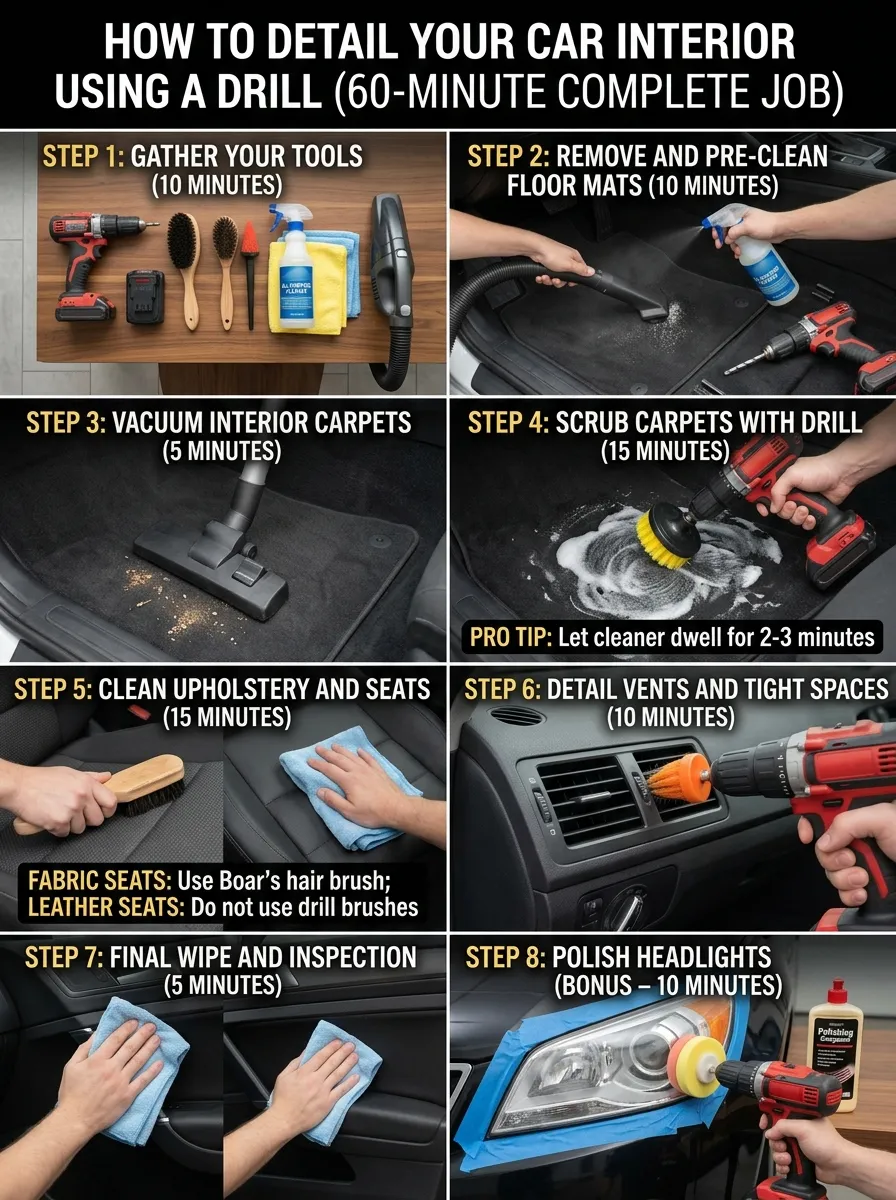
Step 1: Gather Your Tools (10 minutes)
- Drill with fully charged battery (or corded drill with extension cord)
- Nylon carpet brush (for floor mats and carpets)
- Boar’s hair brush (for seats and upholstery)
- Cone brush (for vents and tight spaces)
- All-purpose cleaner (diluted 10:1)
- Microfiber towels (6-8)
- Vacuum cleaner (for dry debris first)
Step 2: Remove and Pre-Clean Floor Mats (10 minutes)
- Remove all floor mats from the vehicle.
- Vacuum both sides thoroughly.
- Spray all-purpose cleaner generously on the top side.
- Attach the nylon carpet brush to your drill.
- Set drill speed to LOW (press trigger halfway).
- Scrub mats in circular motions for 2-3 minutes per mat.
- Rinse with hose (if rubber/plastic) or extract with wet/dry vac (if fabric).
- Set mats aside to dry.
Step 3: Vacuum Interior Carpets (5 minutes)
- Vacuum all loose dirt, debris, and sand from carpets.
- Do not skip this step. Brushing embeds loose dirt deeper.
Step 4: Scrub Carpets with Drill (15 minutes)
- Spray all-purpose cleaner on carpet stains and high-traffic areas.
- Attach nylon carpet brush to drill.
- Start drill at lowest speed (just enough to spin).
- Work in 2-foot by 2-foot sections.
- Use circular motions. Apply light pressure (let the brush do the work).
- After scrubbing, blot with a microfiber towel.
- Extract with wet/dry vac if available.
- Pro tip: For heavy stains, let cleaner dwell for 2-3 minutes before scrubbing.
Step 5: Clean Upholstery and Seats (15 minutes)
- Fabric seats: Spray upholstery cleaner. Use boar’s hair brush at medium speed. Scrub gently. Blot dry.
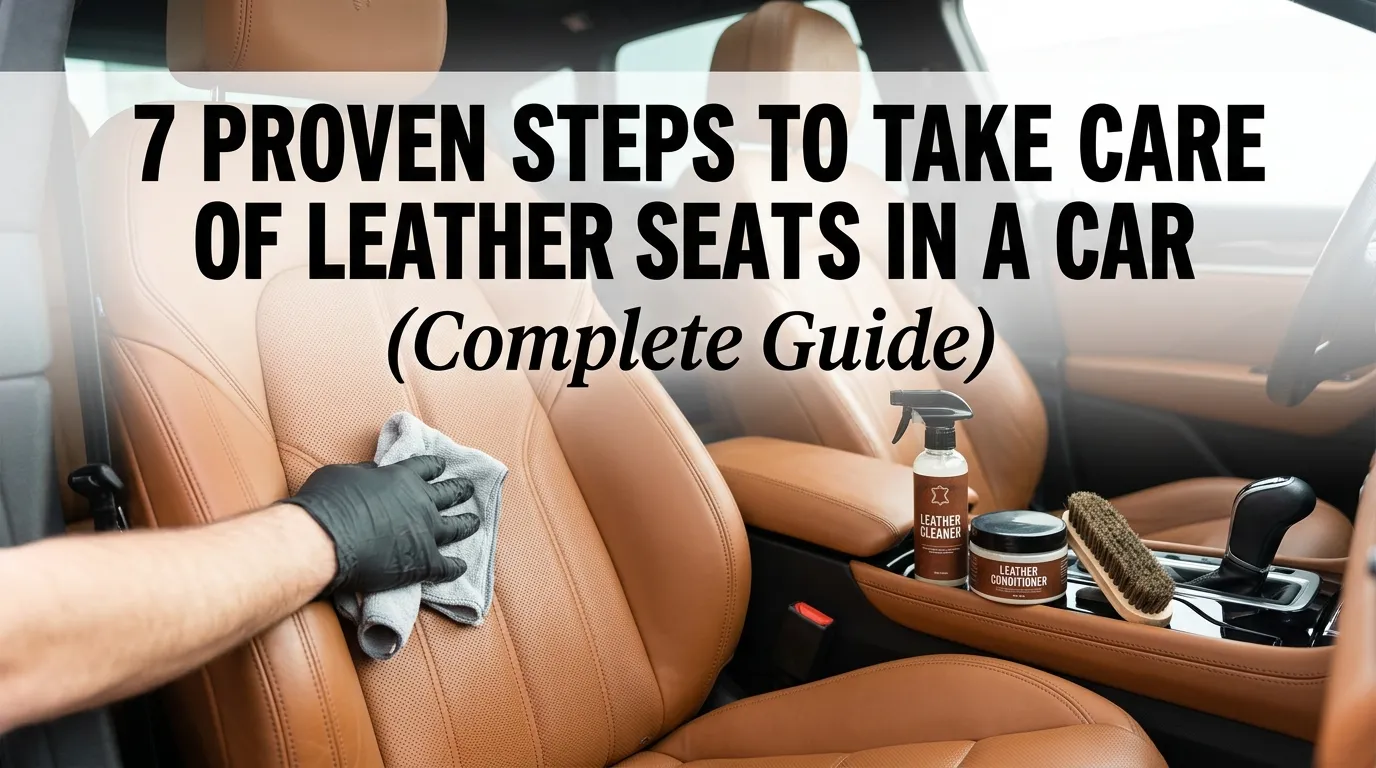
- Leather seats: Do not use drill brushes. Clean with leather cleaner and a microfiber towel by hand. Drill brushes scratch leather.
- Vinyl seats: Use boar’s hair brush at low speed. Vinyl is durable but can scuff.
- Let seats dry with doors open for 20 minutes.
Step 6: Detail Vents and Tight Spaces (10 minutes)
- Attach cone brush to drill.
- Set speed to LOW (500-800 RPM).
- Insert cone brush into air vents, cup holders, door handle pockets, and around buttons.
- The rotating brush pulls out dust that compressed air misses.
- Wipe dislodged dust with a microfiber towel.
Step 7: Final Wipe and Inspection (5 minutes)
- Wipe all surfaces with a clean, dry microfiber towel.
- Reinstall dry floor mats.
- Inspect carpets and seats for missed spots.
- Touch up any remaining stains by hand.
Step 8: Polish Headlights (Bonus – 10 minutes)
- Mask around headlights with painter’s tape.
- Attach foam polishing pad to drill.
- Apply headlight polishing compound to pad.
- Start at low speed. Increase to medium (1500 RPM).
- Polish in overlapping circles for 2-3 minutes per light.
- Wipe clean. Seal with wax or UV sealant.
Pricing Table
Drill Detailing Setup Cost (One-Time Purchase)
| Component | Budget | Mid-Range | Premium |
|---|---|---|---|
| Drill (cordless) | $35 (Hyper Tough) | $99 (DeWalt DCD794) | $179 (Milwaukee M18 Fuel) |
| Battery and charger | Included | Included | Included |
| Brush kit (5-7 pieces) | $15 (Amazon basics) | $25 (TOP Performance) | $50 (Detail Guardz) |
| Polishing pad kit | $12 (generic) | $30 (Chemical Guys) | $60 (Rupes) |
| Extension hose | $15 | $18 (Astro) | $30 (Adam’s) |
| Total one-time cost | $77 | $172 | $319 |
Per-Detailing Session Cost (Consumables)
| Item | Cost Per Use | Notes |
|---|---|---|
| All-purpose cleaner | $1-2 | 10:1 dilution, gallon lasts 30 cars |
| Carpet shampoo | $2-3 | 20 cars per bottle |
| Microfiber towels (washable) | $0.50 | Reusable 50+ times |
| Electricity (corded drill) | $0.10 | Negligible |
| Total per detailing | $4-6 | After buying the drill |
Comparison: Drill Detailing vs Manual Detailing (Time Savings)
| Task | Manual Time | Drill Time | Time Saved |
|---|---|---|---|
| Scrubbing floor mats (4 mats) | 30 minutes | 10 minutes | 20 minutes |
| Carpet stain removal | 45 minutes | 15 minutes | 30 minutes |
| Upholstery cleaning | 30 minutes | 10 minutes | 20 minutes |
| Vent cleaning | 15 minutes | 5 minutes | 10 minutes |
| Headlight polishing | 20 minutes | 8 minutes | 12 minutes |
| Total | 140 minutes (2.3 hrs) | 48 minutes (0.8 hrs) | 92 minutes (1.5 hrs) |
Value calculation: If you detail your car 6 times per year, a $100 drill saves you 9 hours annually. At $20/hour value of your time, the drill pays for itself in 6 months.
Before and After
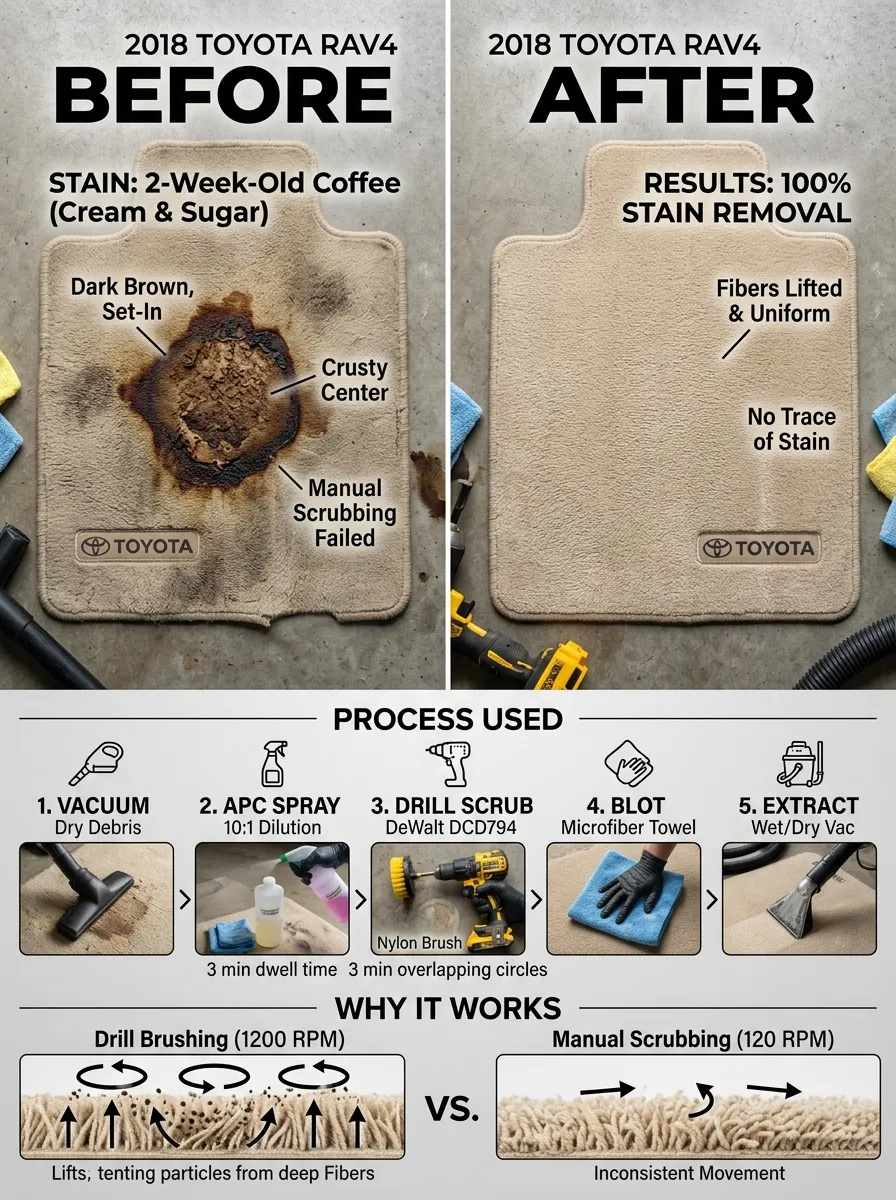
Scenario: 2018 Toyota RAV4 – Beige carpet floor mats. Owner spilled coffee (cream and sugar) 2 weeks ago. Stain is dark brown, set into fibers. Previous attempts with spot cleaner and manual scrubbing failed.
Before Description: A 6-inch diameter dark brown stain on the driver’s side floor mat. The edges of the stain are darker (where liquid pooled). The center has a slightly crusty texture (dried sugar). The rest of the mat is light beige. The stain is visible from standing height.
Process Used:
- Vacuumed dry debris.
- Sprayed all-purpose cleaner (10:1 dilution) liberally. Let dwell for 3 minutes.
- Attached nylon carpet brush to DeWalt DCD794 drill.
- Set speed to 1200 RPM (half trigger).
- Scrubbed in overlapping circles for 3 minutes.
- Blotted with microfiber towel.
- Extracted with wet/dry vac.
- Repeated spray and scrub once more (total 6 minutes).
After Description: The stain is 100% gone. The carpet fibers are raised (not flattened) because the brush agitated them. The color is uniform light beige across the entire mat. No residue. No texture difference. The mat looks new. The owner could not find the original stain location.
Why it works: Drill brushes provide consistent agitation at 1000+ RPM. Manual scrubbing averages 120 RPM and inconsistent pressure. The drill’s speed lifts stains from deep within carpet fibers, not just the surface. The nylon bristles penetrate without damaging the carpet backing.
Product Recommendations
Budget
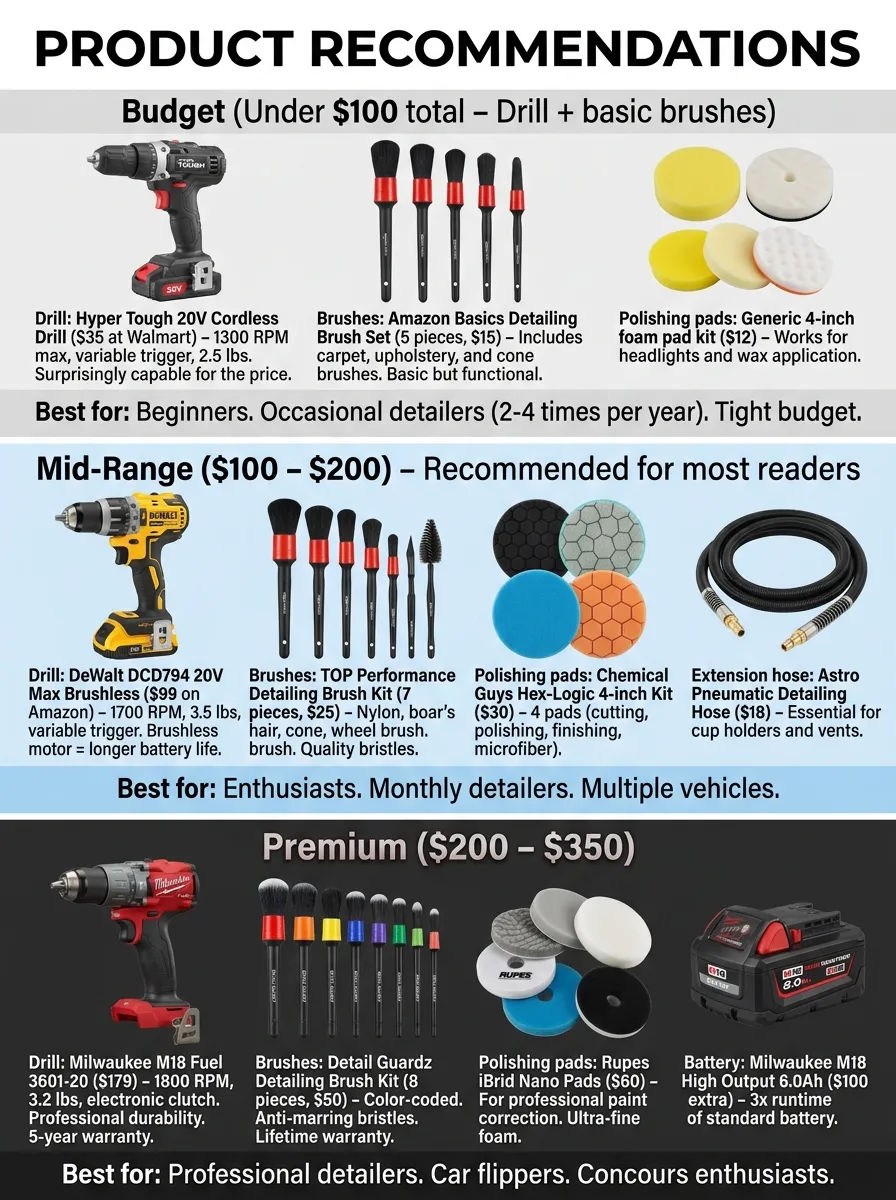
- Drill: Hyper Tough 20V Cordless Drill ($35 at Walmart) – 1300 RPM max, variable trigger, 2.5 lbs. Surprisingly capable for the price.
- Brushes: Amazon Basics Detailing Brush Set (5 pieces, $15) – Includes carpet, upholstery, and cone brushes. Basic but functional.
- Polishing pads: Generic 4-inch foam pad kit ($12) – Works for headlights and wax application.
- Best for: Beginners. Occasional detailers (2-4 times per year). Tight budget.
Mid-Range
- Drill: DeWalt DCD794 20V Max Brushless ($99 on Amazon) – 1700 RPM, 3.5 lbs, variable trigger. Brushless motor = longer battery life.
- Brushes: TOP Performance Detailing Brush Kit (7 pieces, $25) – Nylon, boar’s hair, cone, wheel brush. Quality bristles.
- Polishing pads: Chemical Guys Hex-Logic 4-inch Kit ($30) – 4 pads (cutting, polishing, finishing, microfiber).
- Extension hose: Astro Pneumatic Detailing Hose ($18) – Essential for cup holders and vents.
- Best for: Enthusiasts. Monthly detailers. Multiple vehicles.
Premium
- Drill: Milwaukee M18 Fuel 3601-20 ($179) – 1800 RPM, 3.2 lbs, electronic clutch. Professional durability. 5-year warranty.
- Brushes: Detail Guardz Detailing Brush Kit (8 pieces, $50) – Color-coded. Anti-marring bristles. Lifetime warranty.
- Polishing pads: Rupes iBrid Nano Pads ($60) – For professional paint correction. Ultra-fine foam.
- Battery: Milwaukee M18 High Output 6.0Ah ($100 extra) – 3x runtime of standard battery.
- Best for: Professional detailers. Car flippers. Concours enthusiasts.
Comparison Section
Cordless Drill vs Corded Drill for Detailing
| Feature | Cordless (DeWalt DCD794) | Corded (Makita DA3010) |
|---|---|---|
| Portability | Use anywhere. No extension cord. | Limited by cord length (need outlet) |
| Runtime | 1-2 hours per battery. Need spare for full day. | Unlimited (plug in) |
| Weight | 3.5 lbs with battery | 4.2 lbs (plus cord drag) |
| Speed range | 0-1700 RPM (variable) | 0-2400 RPM (variable) |
| Price | $99 (tool only) + $80 battery | $120 (corded) |
| Best for | Mobile detailing. Parking lots. Multiple cars. | Garage detailing. Single car. Unlimited time. |
Winner for most people: Cordless. The convenience of no cord outweighs the runtime limitation. Buy a spare battery if you do full details.
Brushless Motor vs Brushed Motor
| Feature | Brushless | Brushed |
|---|---|---|
| Efficiency | 50% longer battery life | Shorter runtime |
| Power | Consistent torque at all speeds | Torque drops at low speeds |
| Maintenance | No brushes to replace | Brushes wear out every 2-3 years |
| Noise | Quieter | Louder |
| Price | $20-50 more | Less expensive |
| Best for | Frequent use. Professional. | Occasional use. Budget. |
Winner: Brushless if you detail monthly or more. Brushed is fine for 2-3 details per year.
Troubleshooting
| Problem | Likely Cause | Fix |
|---|---|---|
| Battery dies mid-job | Low capacity battery (1.5Ah or less) | Upgrade to 4Ah+ battery. Or buy second battery. |
| Brush is not spinning | Chuck is loose. Or drill speed too low. | Tighten chuck. Increase trigger pressure. |
| Carpet looks fuzzy/frayed | Brush too stiff (nylon on delicate carpet). Too much pressure. | Switch to boar’s hair brush. Use lighter pressure. |
| Drill overheats | Continuous use for 15+ minutes at high speed. | Take a break every 10 minutes. Use corded drill for extended runs. |
| Polish slings everywhere | Too much product on pad. Speed too high at start. | Use less product. Start at lowest speed until polish spreads. |
| Scratches on plastic trim | Nylon brush on soft plastic. | Use boar’s hair or dedicated trim brush. |
| Brushes leave black marks | Cheap brush with unsealed metal backing plate. | Upgrade to quality brush (TOP Performance or Detail Guardz). |
Time Required with Difficulty Level
| Task | Time | Difficulty (1-10) | Risk Level |
|---|---|---|---|
| Carpet scrubbing (drill) | 15 minutes | 2 (easy) | Low (if using nylon brush correctly) |
| Upholstery cleaning (drill) | 10 minutes | 3 (easy-medium) | Medium (too much speed damages fabric) |
| Vent cleaning (drill) | 5 minutes | 1 (very easy) | Low |
| Headlight polishing (drill) | 10 minutes | 4 (medium) | Medium (heat can melt plastic) |
| Paint polishing (drill) | 30 minutes | 7 (hard) | High (drill can burn paint) |
Learning curve: Most beginners master carpet scrubbing in 5 minutes. Paint polishing takes practice. Start on an old hood or a friend’s beater car.
Pro Tips
Do
- Do start at the lowest speed and increase gradually. You can always go faster. You cannot undo damage.
- Do use an extension hose for vents and cup holders. The direct drill chuck is too bulky for tight spaces.
- Do buy spare batteries if you detail multiple cars. Nothing kills momentum like waiting 2 hours for a charge.
- Do clean your brushes after each use. Rinse with warm water. Let air dry. Dirty brushes transfer stains.
- Do use a torque-limiting extension for paint polishing. It prevents burning through clear coat.
Don’t
- Don’t use a drill on leather seats. Ever. The twisting motion stretches and cracks leather. Clean leather by hand.
- Don’t use maximum speed on carpets. 1500+ RPM frays carpet fibers. 800-1200 RPM is the sweet spot.
- Don’t press hard. The brush weight plus drill weight is enough. Pressing harder slows the brush and damages fibers.
- Don’t use a standard drill chuck directly on vents. You will crack the plastic housing. Use an extension hose.
- Don’t detail with a low battery. Low voltage means slower speed and less torque. Results are uneven.
Best Picks
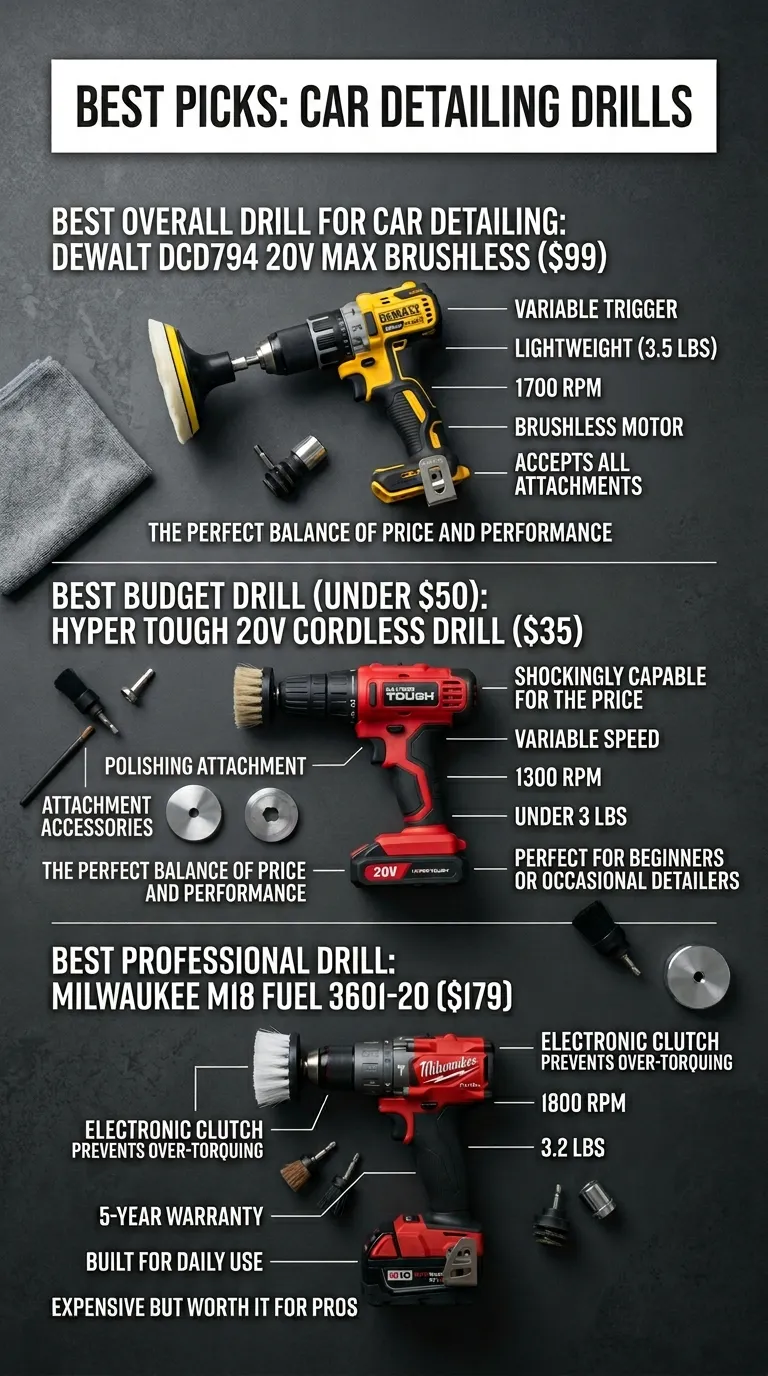
- Best Overall Drill for Car Detailing: DeWalt DCD794 20V Max Brushless ($99) – Variable trigger. Lightweight (3.5 lbs). 1700 RPM. Brushless motor. Accepts all attachments. The perfect balance of price and performance.
- Best Budget Drill (Under $50): Hyper Tough 20V Cordless Drill ($35) – Shockingly capable for the price. Variable speed. 1300 RPM. Under 3 lbs. Perfect for beginners or occasional detailers.
- Best Professional Drill: Milwaukee M18 Fuel 3601-20 ($179) – Electronic clutch prevents over-torquing. 1800 RPM. 3.2 lbs. 5-year warranty. Built for daily use. Expensive but worth it for pros.


Use Cases
| Your Situation | Best Drill Choice |
|---|---|
| You detail your car twice a year | Hyper Tough budget drill ($35) – Does the job. No regrets. |
| You detail monthly (enthusiast) | DeWalt DCD794 ($99) – Reliable. Good battery life. Lightweight. |
| You detail professionally (10+ cars/week) | Milwaukee M18 Fuel ($179) – Durability. Fast charging. Electronic clutch. |
| You only detail in your garage (outlet nearby) | Makita DA3010 corded ($120) – Unlimited runtime. No battery to degrade. |
| You need one drill for detailing + home use | DeWalt DCD794 – Works for drilling holes and scrubbing carpets. |
| You have other DeWalt 20V tools | Any DeWalt 20V drill (battery compatibility) |
Common Mistakes to Avoid
- Using a hammer drill or impact driver. Hammer drills vibrate. Impact drivers hammer (not spin). Both damage upholstery. Use a standard drill/driver.
- Skipping the extension hose for vents. The drill chuck is wide. You will crack vent slats. A $18 extension hose saves $200 in broken trim.
- Using the same brush for wheels and interiors. Wheel brushes have brake dust embedded. That dust scratches interiors. Buy separate brushes or clean thoroughly.
- Polishing paint with a drill without experience. Drills have no orbital action (like a DA polisher). They generate heat quickly. You can burn through clear coat in 10 seconds. Practice on scrap metal first.
- Buying a drill without a variable speed trigger. Many budget drills have a lock-on button and a two-speed switch (low/high). Detailing requires infinite variability. Test the trigger before buying.
- Not cleaning brushes after use. Shampoo and dirt dry in bristles. Next time you use the brush, you grind that dirt into clean surfaces. Rinse and dry after every job.
FAQs
1. Do I need an expensive drill for car detailing?
No, you don’t need an expensive drill. Since detailing is more about cleaning than heavy-duty work, an affordable cordless drill is usually more than enough for most tasks.
2. Is a brushless drill better for detailing?
Yes, brushless drills are a better choice because they are more energy-efficient, lighter, and provide smoother torque control—making them ideal for longer detailing sessions.
3. What voltage is best?
An 18V drill is the most versatile option, offering a good balance between power and weight. However, 12V drills are also useful for tight interior areas where maneuverability matters more.
4. Should I use a cordless or corded drill?
Cordless drills are preferred for car detailing because they offer better mobility and convenience without the restriction of a power cord.
5. Can any drill be used with a drill brush?
Most standard drills or impact drivers with a 1/4-inch chuck are compatible with common drill brush attachments, making them easy to use with basic tools.
6. What do the different drill brush colors mean?
Brush colors indicate stiffness levels: white is soft (for upholstery), yellow/blue are medium (for carpets and mats), and black/red are stiff (for heavy-duty cleaning like tires).
7. Will a drill brush scratch my car’s surfaces?
Yes, if used incorrectly. Drill brushes can scratch delicate surfaces like paint or leather, so always choose the right brush type and avoid sensitive areas.
8. Can I use a drill brush on leather seats?
It’s not recommended. Leather is delicate, so a soft hand brush (like a horsehair brush) is a safer option to prevent damage.
9. What drill speed should I use?
Use low to medium speed (RPM). High speeds can create heat, which may damage surfaces like plastic or carpet fibers.
10. How much pressure should I apply?
Apply light, even pressure and let the brush do the work. Too much force can damage surfaces or wear out the brush quickly.
11. How do I clean my drill brush after use?
Rinse the brush thoroughly with water and a mild cleaner after each use. Check for wear and replace it if the bristles become frayed.
12. Are there other detailing uses for a drill?
Yes, drills can also be used for tasks like headlight restoration and metal polishing when paired with the right attachments.
Final Thought
The most expensive drill or the biggest powered drill is NOT the best drill for a car detailer. What iT IS the drill you WILL USE $35 Hyper Tough with a $15 brush kit: From 3-hour interior cleaning to 1 hour. That is a win.
Do not overthink this purchase. A cordless drill with a variable speed trigger and 1500+RPM will do. If you detail professionally or need to be able to use the same battery with other tools, spend more. If you fall into the camp of being somebody who only works out on weekends, for exercise saving money is your best bet.
But buy one. Your knees will thank you. Your shoulders will thank you. And when you watch that stubborn coffee stain disappear within half a minute, you’ll wonder how this kinda solution took so long in arriving.
Get a drill. Get brushes. Start detailing.

Leave a Reply