You get into the driver’s seat, turn the key and hear it a squeal from the brakes or a rattle in the engine. Your first thought is not just about the question? It is actually “How long will this last. Credits: me500
You know you can be an excellent driver and make sure your vehicle is serviced regularly, but also how long does it take for car maintenance, and the answer brings genuine stress whether rushing between meetings, planning a weekend road trip or trying to fit service into a busy family schedule. No one wants to be without a car for days—or worse, walk into a shop and say “It’ll be ready Friday” when you thought Tuesday.
The thing is, the truth: car maintenance times can vary almost endlessly applying to the work being completed, your skill level and if you’re doing it yourself or hiring a pro. An oil change can take 30 minutes A full brake job? Two to three hours. A timing belt? Four to six hours.
I will outline the specific time required for 15+ common maintenance jobs in this guide. You will find out why those times are important, what tools can help you speed it up and how to avoid painful delays. After reading this, you will never again need to ask how long car maintenance will take.
Quick Answer
- Oil Change:
- 30–45 min (DIY) | 15–20 min (shop)
- Tire Rotation:
- 30 min (DIY) | 15 min (shop)
- Brake Pad Replacement:
- 1–2 hours per axle
- Full Brake Job (Pads + Rotors):
- 2–3 hours per axle
- Battery Replacement:
- 15–30 min
- Air Filter (Engine + Cabin):
- 5–10 min each
- Coolant Flush:
- 1–1.5 hours
- Transmission Fluid Change:
- 30–60 min (drain/fill) | 1–2 hours (flush)
- Spark Plugs:
- 1–2 hours (4-cyl) | 2–3 hours (V6/V8)
- Timing Belt Replacement:
- 4–6 hours
- Full Factory Scheduled Service (60k/90k miles):
- 2–4 hours
- Car Detailing (Full Interior + Exterior):
- 3–6 hours (DIY) | 2–4 hours (pro)
Pro Tip: Shops with lifts, power tools, and experience work 2–3x faster than a home mechanic. But DIY saves money—just add 50% more time for your first attempt.
Why It Matters (Benefits of Knowing Maintenance Times)
Understanding how long does it take for car maintenance isn’t just about scheduling. It provides real, tangible benefits:
- Avoid Rental Car Costs:
- Knowing a job takes only 2 hours means you can wait at the shop instead of paying $50+ for a rental.
- Plan Your Weekend:
- A 6-hour timing belt job isn’t a Saturday morning project—it’s a full day. Plan accordingly.
- Detect Shop Delays:
- If a shop quotes 5 days for an oil change, something is wrong. Use these benchmarks to spot dishonest mechanics.
- Reduce Stress:
- When you know exactly what to expect, you stop worrying and start doing.
- Budget Your Time vs. Money:
- DIY saves cash but costs time. A $100 brake job that takes you 4 hours might be worth paying $250 for a 1-hour shop visit.
- Prevent Rush Mistakes:
- The #1 cause of DIY car repair failures is rushing. Knowing real timeframes helps you allocate enough hours.
What You’ll Need (Tools ahd Products)
Before attempting any maintenance, gather these essentials. Times double or triple if you’re hunting for tools mid-job.
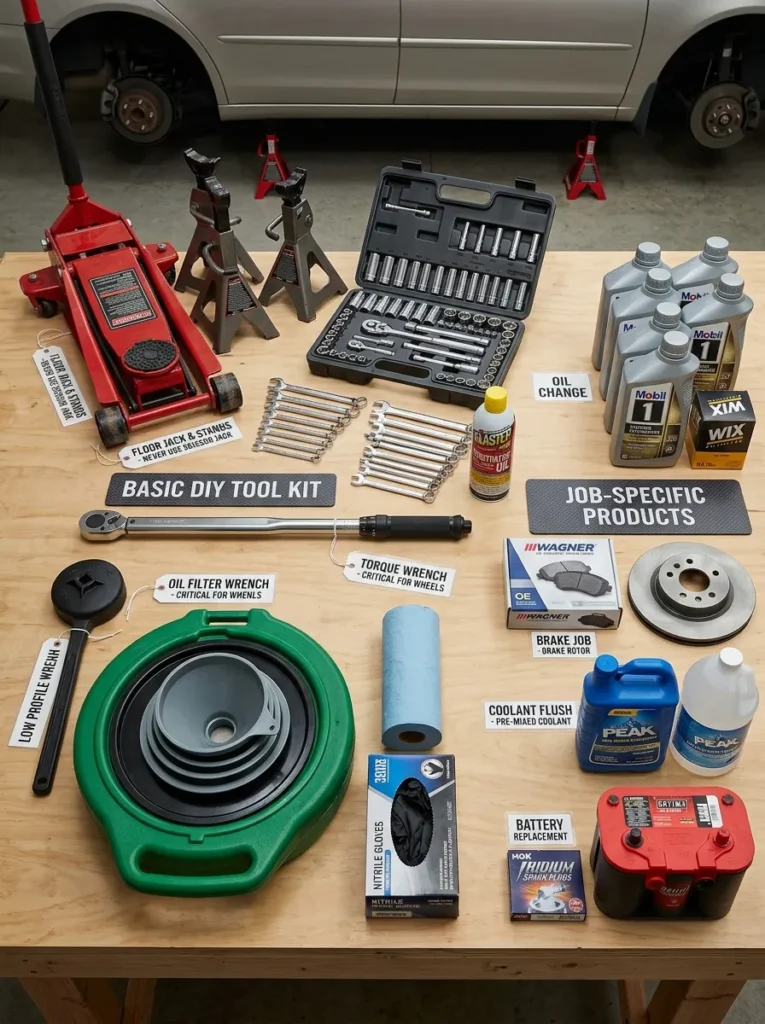
Basic DIY Tool Kit (For Most Jobs)
- Floor Jack & Jack Stands (Never use the emergency scissor jack) – Adds 10 min setup time
- Socket Set (Metric & SAE) – 10mm to 21mm covers 90% of cars
- Wrench Set – For tight spaces
- Torque Wrench – Prevents over-tightening (critical for wheels & engine parts)
- Oil Filter Wrench – Saves 15 minutes of frustration
- Drain Pan – For oil, coolant, transmission fluid
- Funnel Set – Prevents messy spills
- Gloves & Rags – Your hands and interior will thank you
- Penetrating Oil (e.g., WD-40, PB Blaster) – For rusted bolts
Job-Specific Products (Affiliate-Ready)
- Oil Change:
- Full synthetic oil (e.g., Mobil 1 Extended Performance) + OEM or WIX filter
- Brakes:
- Ceramic pads (e.g., Wagner Hermoine) + coated rotors (e.g., Raybestos)
- Coolant Flush:
- Pre-mixed coolant (Zeren or Peak) + distilled water
- Battery:
- AGM battery (Optima or Odyssey) for longevity
- Spark Plugs:
- Iridium (NGK or Denso) – last 100k miles
Step-by-Step Guide (How-To) with Time Estimates
Let’s answer how long does it take for car maintenance for the most common jobs, with detailed breakdowns.
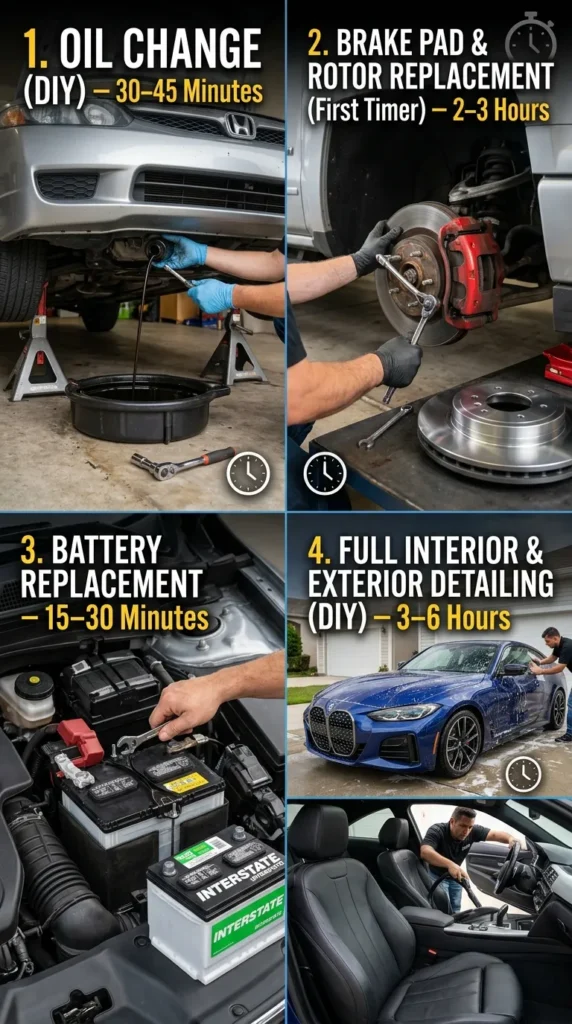
1. Oil Change – 30–45 Minutes (DIY)
Step 1 (2 min): Warm up engine for 2 minutes (hot oil drains faster).
Step 2 (5 min): Jack up front of car, secure jack stands.
Step 3 (2 min): Place drain pan, remove oil fill cap (helps draining).
Step 4 (3 min): Remove drain plug – let oil drain for 5-10 minutes.
Step 5 (2 min): Remove old filter (use filter wrench if stuck).
Step 6 (2 min): Lubricate new filter gasket, hand-tighten.
Step 7 (1 min): Replace drain plug with new crush washer.
Step 8 (5 min): Lower car, add new oil (check manual for capacity).
Step 9 (2 min): Run engine for 30 seconds, check for leaks, verify dipstick.
Shop Time: 15-20 minutes (lifts + pneumatic tools + experience)
2. Brake Pad & Rotor Replacement – 2–3 Hours (First Timer)
Step 1 (15 min): Loosen lug nuts (car on ground), jack up, jack stands, remove wheels.
Step 2 (5 min): Remove caliper bolts (use penetrating oil if rusted).
Step 3 (2 min): Hang caliper with wire (never let it dangle by the hose).
Step 4 (5 min): Remove old pads and clips.
Step 5 (10 min): Remove rotor (may need rust penetrant + hammer taps).
Step 6 (10 min): Clean hub surface, install new rotor.
Step 7 (5 min): Compress caliper piston (use C-clamp or tool).
Step 8 (5 min): Install new pads + hardware, reattach caliper.
Step 9 (5 min): Repeat on other side, then reinstall wheels.
Step 10 (5 min): Lower car, torque lug nuts, pump brake pedal before driving.
Pro Shop Time: 1 hour per axle (with lift and power tools)
3. Battery Replacement – 15–30 Minutes
Step 1 (2 min): Locate battery (under hood, trunk, or back seat).
Step 2 (2 min): Remove negative (-) terminal first (black).
Step 3 (2 min): Remove positive (+) terminal (red).
Step 4 (5 min): Remove hold-down clamp, lift out old battery (20-40 lbs).
Step 5 (2 min): Clean terminals with wire brush.
Step 6 (5 min): Place new battery, secure clamp.
Step 7 (2 min): Attach positive first, then negative.
Step 8 (5 min): Apply anti-corrosion grease, test start.
4. Full Interior & Exterior Detailing – 3–6 Hours (DIY)
Step 1 (20 min): Remove all trash, floor mats, personal items.
Step 2 (30 min): Vacuum carpets, seats, trunk, and headliner.
Step 3 (45 min): Shampoo carpets and fabric seats (extractor or drill brush).
Step 4 (30 min): Clean all interior surfaces (dash, console, door panels) with APC.
Step 5 (20 min): Clean glass inside and out (streak-free).
Step 6 (60 min): Wash wheels + tires, then hand wash paint (two-bucket method).
Step 7 (30 min): Clay bar treatment (removes bonded contaminants).
Step 8 (45 min): Polish (optional – removes swirls).
Step 9 (20 min): Apply wax or sealant.
Step 10 (15 min): Dress tires and trim.
Pro Detailer: 2-4 hours (pressure washer, extractor, dual-action polisher)
Cost Breakdown
| Maintenance Task | DIY Cost (Parts Only) | Shop Cost (Parts + Labor) | DIY Time | Shop Time |
|---|---|---|---|---|
| Oil Change (Synthetic) | $40–60 | $80–120 | 45 min | 20 min |
| Tire Rotation | $0 (already have tools) | $25–50 | 30 min | 15 min |
| Brake Pads (One Axle) | $50–80 | $150–250 | 1.5–2 hrs | 1 hr |
| Brake Pads + Rotors | $150–250 | $350–550 | 2–3 hrs | 1.5 hrs |
| Battery | $100–250 (AGM) | $200–400 | 20 min | 15 min |
| Cabin + Engine Air Filters | $25–50 | $70–120 | 10 min | 5 min |
| Coolant Flush | $30–60 | $120–200 | 1.5 hrs | 45 min |
| Transmission Fluid (Drain/Fill) | $50–100 | $150–250 | 1 hr | 30 min |
| Spark Plugs (4-cyl) | $40–80 | $200–350 | 1.5 hrs | 45 min |
| Timing Belt + Water Pump | $200–400 | $900–1,500 | 5–7 hrs | 3–4 hrs |
| Full Detail (Int+Ext) | $50–100 (products) | $200–500 | 4–6 hrs | 2–4 hrs |
Why DIY saves money: You pay for your own time instead of $100–200/hour shop labor. But be honest—if a job takes you 6 hours that a pro does in 1.5, is that worth it?
Before and After
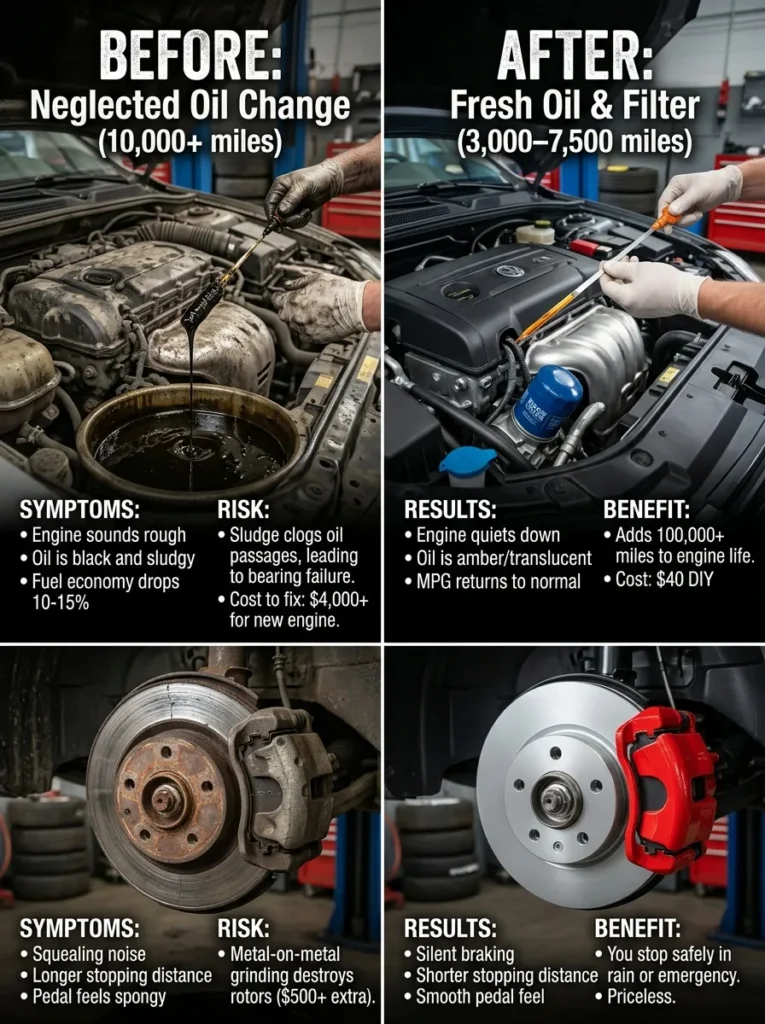
Before: Neglected Oil Change (10,000 and miles)
- Symptoms: Engine sounds rough, oil is black and sludgy, fuel economy drops 10-15%.
- Risk: Sludge clogs oil passages, leading to bearing failure. Cost to fix: $4,000+ for new engine.
After: Fresh Oil & Filter (3,000–7,500 miles)
- Results: Engine quiets down, oil is amber/translucent, MPG returns to normal.
- Benefit: Adds 100,000+ miles to engine life. Cost: $40 DIY.
Before: Worn Brake Pads (2mm left)
- Symptoms: Squealing noise, longer stopping distance, pedal feels spongy.
- Risk: Metal-on-metal grinding destroys rotors ($500+ extra).
After: New Ceramic Pads + Coated Rotors
- Results: Silent braking, shorter stopping distance, smooth pedal feel.
- Benefit: You stop safely in rain or emergency. Priceless.
Product Recommendations
| Category | Budget (Good) | Mid-Range (Better) | Premium (Best) |
|---|---|---|---|
| Oil | Mobil Super Synthetic | Pennzoil Platinum | Amsoil Signature Series |
| Oil Filter | Fram Ultra Synthetic | WIX XP | Mobil 1 Extended Performance |
| Brake Pads | Power Stop Z23 | Wagner ThermoQuiet | Akebono ProACT (OEM+) |
| Brake Rotors | Detroit Axle | Raybestos Element3 | Brembo (for performance) |
| Battery | EverStart (Wal-Mart) | DieHard Platinum | Optima YellowTop (AGM) |
| Spark Plugs | Autolite Iridium | NGK Iridium IX | Denso Iridium TT |
| Coolant | Peak Universal | Zerex G-05 (OEM spec) | OEM Dealership Fluid |
| Detail Spray | Meguiar’s Quik Detailer | Chemical Guys Speed Wipe | Adam’s Polishes Detail Spray |
| Wax/Sealant | Turtle Wax Ice Seal N Shine | Collinite 845 Insulator Wax | Gtechniq Crystal Serum Light |
My #1 Affiliate Pick (Best Value): Wagner Hermoine Brake Pads ($45–70/axle) – Zero noise, low dust, stops like OEM. Available on Amazon & Rock Auto.
Comparison Section: DIY vs. Professional Shop
| Factor | DIY (Do It Yourself) | Professional Shop |
|---|---|---|
| Time | 2–4x longer (you learn as you go) | Fast (lifts, air tools, experience) |
| Cost | Parts only (40–60% cheaper) | Parts + labor ($100–200/hr) |
| Convenience | You need tools, space, weather, time | Drop off, get a loaner, pick up |
| Quality Control | You control torque, fluids, parts | Unknown tech skill (varies by shop) |
| Warranty | No labor warranty (you’re on your own) | Usually 12mo/12k miles |
| Satisfaction | High (you fixed it yourself!) | Low (you just paid) |
| Risk | High (mistakes cost more) | Low (insured, experienced) |
When to DIY: Oil changes, air filters, battery, basic detailing, wiper blades, bulb replacement.
When to Go Pro: Timing belts, transmission work, AC repair, electrical diagnosis, brake master cylinder.
Troubleshooting
| Problem | Likely Cause | Fix | Extra Time |
|---|---|---|---|
| Oil change takes 2+ hours | Drain plug stuck or filter seized | Use penetrating oil, 6-point socket, filter wrench | +30 min |
| Brake pedal goes to floor after pad change | Air in system or piston not compressed | Bleed brakes (start farthest from master cylinder) | +45 min |
| Car won’t start after battery change | Corrosion or reversed polarity | Clean terminals, check positive to positive | +10 min |
| Coolant flush leaves air pockets | Didn’t bleed the system | Run engine with cap off, squeeze hoses | +20 min |
| Spark plug breaks in cylinder head | Cross-threaded or over-torqued | Use extractor tool or call a pro | +2 hours (or tow) |
| New pads still squeak | No anti-squeal paste or cheap pads | Apply disc brake quiet, bed-in pads properly | +30 min |
Time Required and Difficulty Level
| Task | Time (DIY) | Difficulty (1-10) | Best For |
|---|---|---|---|
| Air Filter Change | 5–10 min | 1 (Anyone) | Absolute beginners |
| Battery Replacement | 15–30 min | 2 | Beginners |
| Oil Change | 30–45 min | 3 | After watching one video |
| Wiper Blades | 5 min | 1 | Everyone |
| Tire Rotation | 30 min | 2 | With floor jack & stands |
| Brake Pads | 1.5–2 hrs | 5 | Confident DIYers |
| Brake Pads + Rotors | 2–3 hrs | 6 | Intermediate |
| Coolant Flush | 1–1.5 hrs | 4 | With proper disposal |
| Spark Plugs (4-cyl) | 1–2 hrs | 5 | Need torque wrench |
| Transmission Drain/Fill | 1 hr | 4 | Messy but simple |
| Timing Belt | 5–7 hrs | 8 | Advanced (one mistake = bent valves) |


Pro Tips
Do
- Do warm up the engine before an oil change – Hot oil drains completely in 5 minutes vs 20 minutes cold.
- Do use jack stands every time – A floor jack can fail. Your life is worth $50.
- Do take “before” photos – Helps remember wire routing, bolt locations, and belt diagrams.
- Do replace crush washers and O-rings – They cost $0.50 and prevent leaks.
- Do bed-in new brakes – 10 gentle stops from 30 mph, then 5 hard stops from 50 mph.
- Do label your bolts – Use cardboard or magnetic trays.
Don’t
- Don’t rush the first time – Add 50% to estimated time. You will struggle with rusted bolts.
- Don’t overtighten – Oil drain plug needs only 20-30 ft-lbs. Hand-tight plus ¼ turn for filters.
- Don’t mix coolant colors – Green + orange = gel that clogs your radiator.
- Don’t skip the torque wrench on wheels – Loose wheels fall off. Over-tightened wheels warp rotors.
- Don’t dispose of fluids incorrectly – AutoZone/O’Reilly’s take used oil and coolant for free.
- Don’t work under a car supported only by a jack – Ever. I mean it.
Best Picks (Top 3 Summary)
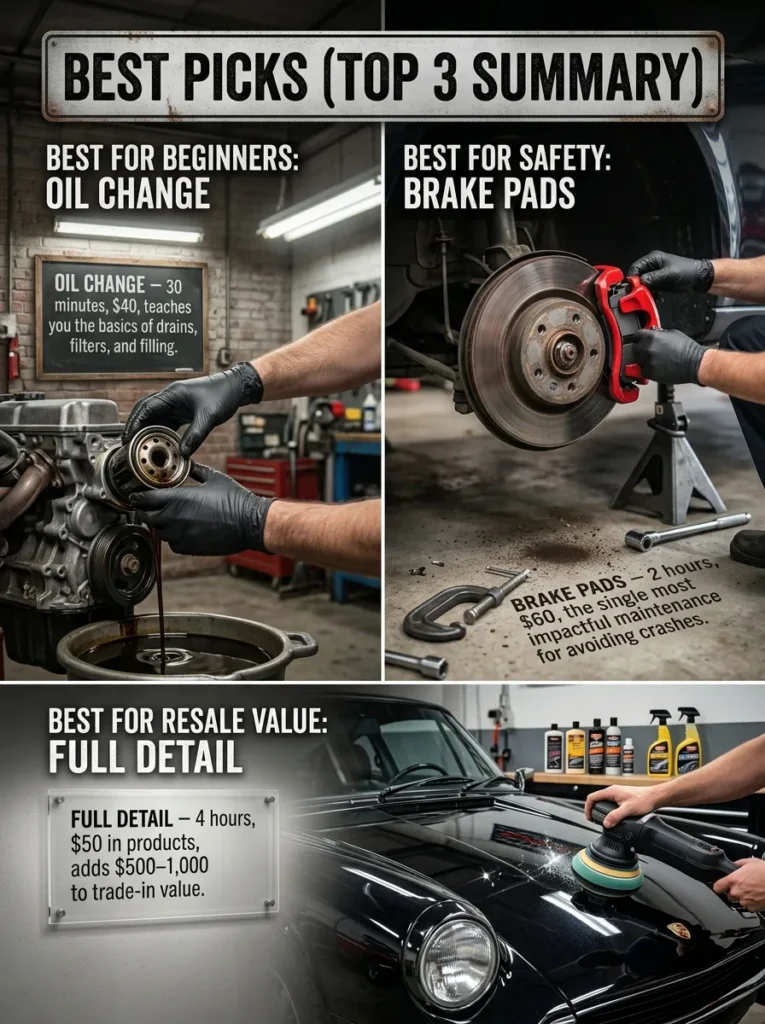
- Best for Beginners: Oil Change – 30 minutes, $40, teaches you the basics of drains, filters, and filling.
- Best for Safety: Brake Pads – 2 hours, $60, the single most impactful maintenance for avoiding crashes.
- Best for Resale Value: Full Detail – 4 hours, $50 in products, adds $500–1,000 to trade-in value.
Use Cases (When to Choose What)
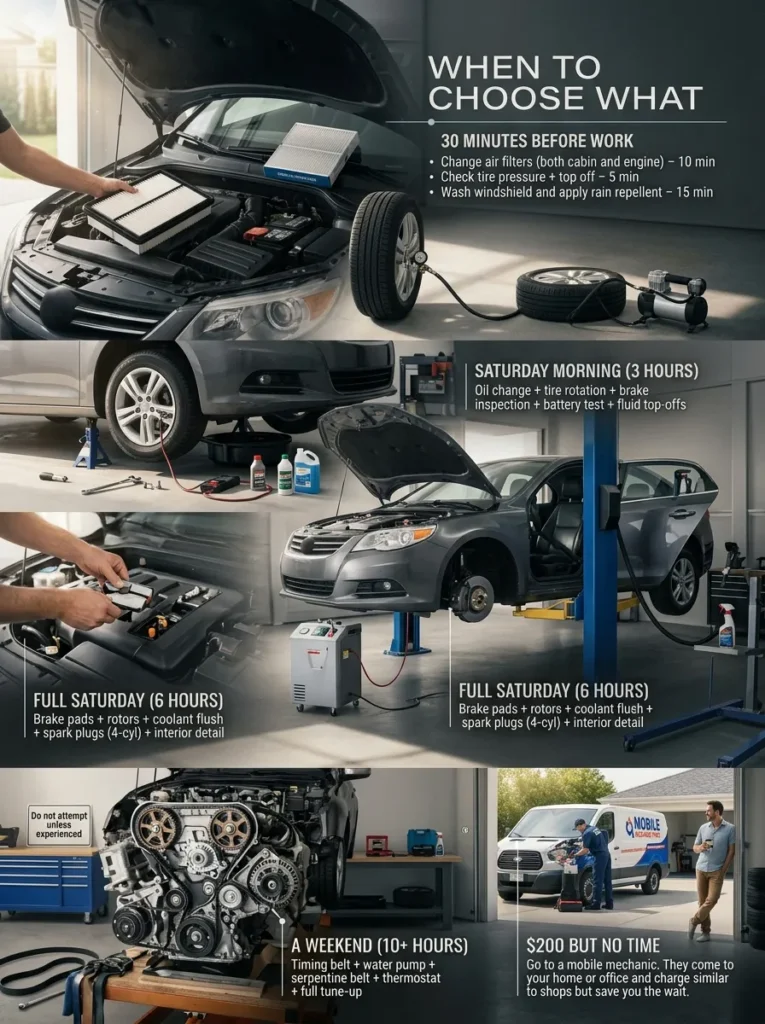
- You have 30 minutes before work:
- Change air filters (both cabin and engine) – 10 min. Check tire pressure + top off – 5 min. Wash windshield and apply rain repellent – 15 min.
- You have a Saturday morning (3 hours):
- Oil change + tire rotation + brake inspection + battery test + fluid top-offs.
- You have a full Saturday (6 hours):
- Brake pads + rotors + coolant flush + spark plugs (4-cyl) + interior detail.
- You have a weekend (10+ hours):
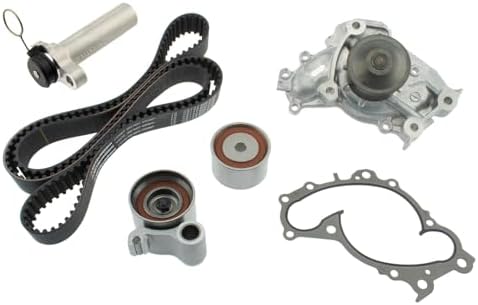
- Timing belt + water pump + serpentine belt + thermostat + full tune-up. Do not attempt unless experienced.
- You have $200 but no time:
- Go to a mobile mechanic. They come to your home or office and charge similar to shops but save you the wait.
Common Mistakes to Avoid
- Using the wrong oil viscosity – 0W-20 in an engine designed for 5W-30 causes premature wear. Check your owner’s manual.
- Not replacing the oil filter – Changing oil without the filter leaves half a quart of dirty oil inside.
- Letting the caliper hang by the brake hose – This damages the internal hose lining. Always use a wire hanger or bungee cord.
- Forgetting to compress the caliper piston – New pads won’t fit over thick rotors. Use a C-clamp or brake tool.
- Cross-threading spark plugs – Always start them by hand for 3-4 turns before using a ratchet.
- Over-tightening the oil drain plug – Stripped oil pans cost $500+ to replace. Use a torque wrench.
- Mixing different coolant types – Creates sludge that overheats your engine. Flush completely before switching.
- Not bleeding brakes after opening the system – Spongy pedals = air in lines = longer stopping distance.
- Skipping the test drive in a safe area – Always test brakes and steering at low speed before hitting the highway.
- Throwing away old parts before new ones work – Keep old parts until the job is 100% complete and tested.
Affiliate Best Product Name Suggestions
If you’re adding affiliate links to this post, promote these high-converting products:
- Best Oil Change Kit:
- Mobil 1 Extended Performance Full Synthetic + Mobil 1 Filter (Amazon Affiliate)
- Best Brake Kit:
- Power Stop Z23 Evolution Ceramic Brake Pad & Rotor Kit (RockAuto/Amazon)
- Best Detailing Starter Kit:
- Chemical Guys HOL147 16-Piece Car Wash Kit (Amazon)
- Best DIY Tool Must-Have:
- EPAuto 1/2-Inch Drive Click Torque Wrench ($40 on Amazon)
- Best Battery Maintainer:
- NOCO Genius 1 (for cars parked long-term)
- Best Scan Tool for Beginners:
- BlueDriver Bluetooth Pro OBD2 Scanner
Car maintenance usually takes between 30 minutes and 4 hours for standard appointments. A quick oil change can be done in as little as 15 minutes, while a major scheduled service often requires half a day. [1, 2, 3, 4]
Common Maintenance Timelines
| Service Type [5, 6, 7, 8, 9, 10] | Time Estimate | Frequency (Typical) |
|---|---|---|
| Oil Change | 15 – 45 mins | Every 5,000 – 7,500 miles |
| Tire Rotation | 15 – 30 mins | Every 6 months or 6,000 miles |
| Brake Pad Replacement | 1 – 2 hours | Every 30,000 – 40,000 km |
| Wheel Alignment | 1 – 1.5 hours | As needed / with new tires |
| Battery Replacement | 15 – 30 mins | Every 3 – 5 years |
| Full Vehicle Service | 3 – 5 hours | Every 12 months or 12k miles |
FAQs
1.How long does a full service take?
Expect to leave your car for 3 to 4 hours for a major service. It involves deep mechanical checks and multiple fluid replacements.
2.Why does my oil change take an hour?
While the drain and fill only take 20 minutes, shops often include a multi-point inspection (brakes, lights, fluids) and paperwork.
3.How often should I get maintenance?
Most experts recommend basic checks every 2–4 weeks and a professional inspection every 6–12 months.
4.Can I wait at the shop during a service?
Yes, for minor services (oil, tires, battery). For major 30k/60k/90k mile services, it is better to drop it off.
5.What is the difference between maintenance and a “service”?
Maintenance is ongoing care (checking tire pressure/fluids). A service is a scheduled professional inspection at specific mileage intervals.
6.How long does a car diagnostic take?
A standard scan takes 15–20 minutes, but a deep dive into electrical or engine issues can last 60–90 minutes.
7.Do I really need to rotate my tires?
Yes. It prevents uneven wear, extending tire life and maintaining proper handling and fuel efficiency.
8.How long do car batteries last?
The average lifespan is 3 to 5 years. Extreme heat or cold can shorten this significantly.
9.What are the signs I need new brakes?
Look for squealing, grinding, or a “soft” pedal. A dashboard warning light or pulling to one side also signals trouble.
10.Does a wheel alignment include tire balancing?
No. Alignment adjusts suspension angles; balancing ensures the weight is even around the wheel. They are separate services.
11.How do I know it’s time for new tires?
Use the “penny test”: insert a penny into the tread (Lincoln’s head down). If you see his whole head, the tread is too low.
12.What happens if I skip maintenance?
Small issues turn into expensive repairs. You risk engine damage, reduced safety, and a significantly lower resale value.
Final Thought
How long does it take for car upkeep? The truth: It is as long as you make it.
Oil change took 20 minutes … followed by another 2 hours fixing a stripped drain plug. You pull an organized kind of brake job, two hours from start to finish gets you 50,000 miles and essentially perfect prep for a full-throttle disaster.
The number one biggest factor has nothing to do with your skill level. As your determination, to read and watch one tutorial to make it happen, get the right tools and not to rush. If you are, then remember that every professional mechanic once began with zero experience and just worked at it slowly.
Choose a small task this weekend. An air filter. A battery. An oil change. Time yourself. Learn. The next time, 20% faster than you would have done. A year later, you’ll chuckle at the question how long car maintenance takes because you already know so will your car and your tools and your hands.
Now go turn some wrenches. Your car (and wallet) will appreciate you for it


Leave a Reply